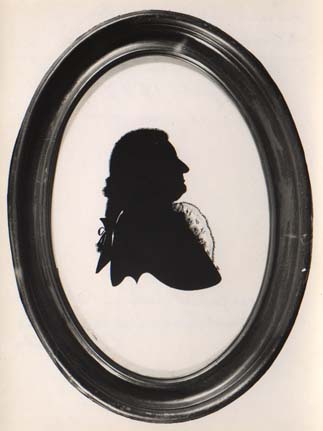
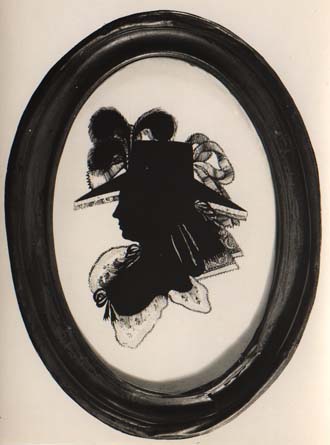
Silhouettes
These silhouettes were in the possession of Miss Evelyn de la Cherois Crommelin who stated
they were taken over to Ireland by Louis Crommelin in 1698. The frames are bronze and the
likeness cut in black and placed onto the glass. The decorations were made upon the glass
by a goose-quill. They still retain their jet-black colour.
The Victoria & Albert Museum authorities stated that the first silhouettes known in England
are two of King William III and Queen Mary, dated 1699.
Samuel-Louis Crommelin introduced the linen industry to Ireland. He was born at St. Quentin and
died at Lisburn, Ireland on 17 July 1727 aged 75 years. He is buried at Lisburn Cathedral
churchyard.
His wife, Anne Crommelin, was his cousin - the daughter of Samuel Crommelin and Madeleine
Testart. She was born at St. Quentin 22 February 1659 and died at Lisburn, 15 August 1755 and
is also buried at the same location.

Memorial at Christ Church Cathedral cemetery, Lisburn
(Click to enlarge)
Samuel-Louis Crommelin (1652-1727)
Director of Irish linen enterprise, was born in May 1652 at Armandcourt, near St. Quentin, Picardy,
where his ancestry had long been landowners and flax-growers. His father, Louis Crommelin (married
in 1648 to Marie Mettayer), was sufficiently wealthy to leave 10,000 l. to each of his four sons,
Samuel-Louis, Samuel, William, and Alexander. Louis Crommelin, who, on his father's death, appears
to have dropped the prefix Samuel, gave employment to many hands in flax-spinning and linen-
weaving. The family was Protestant, and the revocation of the Edict of Nantes in 1685 proved the
ruin of their business.
Samuel-Louis Crommelin for some years endeavoured to hold his ground; he had reconciled himself to the
Roman Catholic church in 1683, but becoming again a Protestant, his estates were forfeited to the
crown and his buildings wrecked. With his son and two daughters he made
his way to Amsterdam. Here he became partner in a banking firm and was joined by his brothers,
Samuel and William.

Click for aerial view
Many exiled Huguenot linen-workers had been encouraged to settle at Lisburn (formerly
Lisnegarvey), a cathedral town on the confines of counties Antrim and Down, where already there
was some manufacture of linen. In 1696 the English parliament passed an act (7 and 8 Will.III, cap. 39)
for inviting foreign Protestants to settle in Ireland, and admitting all products of hemp and flax
duty free from Ireland to England. The Irish parliament in November 1697 passed an act for
fostering the linen manufacture.
William III, in reply to an address from the English commons on 9 June 1698, expressed his
determination, while discouraging the Irish woollen trade, to do all in his power to encourage
the linen manufactures of Ireland. With this view the king made a communication to Crommelin,
desiring him to institute an inquiry into the condition of the French colony at Lisburn, and
to report upon the terms on which he would agree to act as director of the linen manufacture.
Crommelin arrived at Lisburn in the autumn of 1698. He embodied his ideas respecting the best
mode of improving the linen industry in a memorial dated 16 April 1699, and addressed to the
commissioners of the treasury. The treasury, in concert with the commissioners of trade and
plantations, recommended the adoption of Crommelin's proposals, and effect was at once given
to them by a royal patent. Crommelin, who was made 'overseer of the royal linen manufacture of
Ireland', advanced 10,000 l. to carry out the necessary works, the treasury paying him eight
per cent on this sum for ten years. He was to have 200 l. a year as director, and 120 l. a year
for each of three assistants. A grant of 60 l. was added towards the stipend of a French minister,
and early in 1701 Charles Lavalade (whose sister, Madeleine, had married Alexander Crommelin) became the
pastor of the colony. The death of William III in 1702 imperilled the rising enterprise, but the royal patent and
grants were renewed under Anne.
REV CHARLES DE LA VALADE
The Comte De La Valade held lands in Languedoc, but two of his sons were Pastors and so had to leave their country at the Revocation. They took with them their younger sister, Madeleine, and escaped to Holland. Their elder sister married James Du Bourdieu of Montpellier, and after his execution during the "Dragonade" escaped to England, carrying her baby son to Switzerland, Holland and London.
When the De La Valade brothers were in Holland, Madeleine married Alexander Crommelin, a brother of Louis Crommelin, and when the Crommelins went to London, the De La Valades accompanied them. In 1699 the Rev. Charles De La Valade appears in the register of the Huguenot Church in Threadneedle Street as a Pastor, but in 1704 he was replaced by the Rev. Jacques Saurin, and it seems he came to Lisburn, again travelling with Alexander Crommelin. He was pastor of the French Church in Lisburn for over forty years. He made his will in 1755 and died in 1756. His brother succeeded him for a short time until he was followed by the Rev. Saumarez Du Bourdieu. Madam Charles De La Valade signed her will in 1759, after the death of her husband. Their daughter, Anne, married George Russell of Lisburn and is thought to have descendants. The Rev.Charles De La Valade seems to have dropped the prefix De, because on the lease of a tenement on the east side of the Market Place from the Marquis of Hertford (it would appear to be one of the houses with its front to the Market Square and its back to the Cathedral), his signature is Charles La Valade. Further signatures of this name all omit the 'De', such as Alan La Valade, who was a godfather in 1733. It is possible that this was the un-named brother, who had a family. In the index of wills, Charles La Valade, 1755-1827, is noted, and in the marriage bonds of Down and Connor and Dromore are the names Peter La Valade and Catherine Durry in 1793. There is more evidence of this family living near Lisburn and Moira, and some of their relations live in Norfolk.
Source
Crommelin began by ordering three hundred looms (afterwards increased to a thousand) from
Flanders and Holland. Till his death a premium of 5 l. was granted for every loom kept going.
The old Irish spinning-wheel he considered superior to any in use abroad; but he employed
skilled workmen to still further improve it. His reed maker was Henry Mark du Pre (d.1750), one
of the best makers of Cambray. Baron Conway gave a site for weaving workshops, and in addition
to the Huguenot weavers, Irish apprentices were taken. Dutchmen were engaged to teach
flax-growing to farmers, and to superintend bleaching operations. It is not without some reason that
Crommelin has been credited with originating, as regards Ulster, a system of technical education
for the textile art. The effect was to supply the markets of Dublin and London with linens and cambrics of a quality
previously procurable only by importation from abroad.
Crommelin was effectively assisted by his three brothers. In 1705 a factory was opened at
Kilkenny, under the management of William Crommelin. In 1707 the thanks of the Irish parliament
were voted to Crommelin. The minutes of the linen board, a body of trustees appointed (13 Oct. 1711)
by the Irish government for the extension of the linen manufacture, bear frequent testimony to
the 'invaluable service' of Crommelin. He pursued his work bravely, though a heavy private
sorrow fell upon him in the death of his only son, Louis, born at St. Quentin, who died at
Lisburn on 1 July 1711, aged 28. By the death of his son a pension of 200 l. a year was lost.
It had been offered to Crommelin, but at his desire was given to his son. On 24 February 1716
the linen board recommended that a pension of 400 l. be granted him by the government.
In December 1717, Crommelin extended his operations by promoting settlements for the manufacture
of hempen sailcloth at Rathkeale, Cork, Waterford, and later at Rathbride (1725). His energy
ceased only with his life; he died at Lisburn on 14 July 1727, aged 75, and is buried, with
other Huguenots, in the eastern corner of the graveyard of the cathedral church. He left a
daughter, married to Captain de Berniere. The Crommelin family is extinct in the main line, but
the name survives, having been adopted by a branch of the family of de la Cherois, closely
connected by marriage with the Crommelins.
Crommelin published an 'Essay Towards the Improving of the Hempen and Flaxen Manufactures
in the Kingdom of Ireland', Dublin, 1705, containing many particulars of historical as well as
scientific interest.
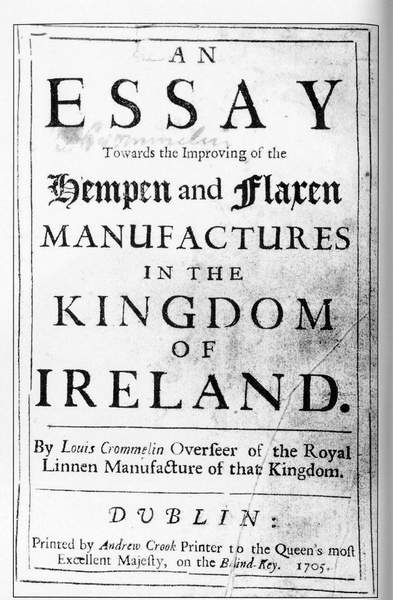
Photo Source
Source: Article from some unknown encyclopedia signed 'A.G.' which gives the following references:
- Ulster Journal of Archaeology, 1853, pp. 209 (article on the 'Huguenot Colony at Lisburn,' by
Dr. Purdon)
- Page 206 (article 'The Settlement in Waterford,' by Reverend T. Gimlette)
- La France Protestante, 2nd edit. by Bordier, 1884 (article 'Crommelin')
- Northern Whig, 12 July 1885 (article on 'Louis Crommelin', by Hugh McCall, Lisburn)
- English Commons Journals, xii, 338 sq.
- Report from the Select Committee on the Linen Trade in Ireland, 6 June 1825; communication
from Mr. McCall.