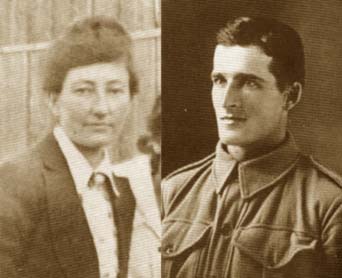
Here we present the song Coquelicot and a short story All's Well and Cheerio by Denis Kevans whose 1970's Sydney University MA thesis was on the poetry of Henry Pryce. The song lyrics were co-written about 65 years earlier by Henry Weston Pryce, brother of Charles Gifford Pryce (the subject of both the poem and the short story). Denis wrote All's Well and Cheerio in 2003 and entered it in a short story competition where it won second prize.
Sonia Bennett, author of The Sydney Rose, a song mentioned in the attached short story, often travels up from Western Sydney for the Parakeet Poetry evening at Katoomba, Australia where she has been known to sing that song, accompanying herself on guitar.
Where time, wind, tide and the glancing waves have scooped and sculptured the faun and fox-brown sandstone, to an unbreaking Pacific roller of time, two ghosts can be seen embracing in the jaculant spray from the waves. They are locked in an endless kiss, and they appear, every time the spray is thrown, a shadow on the stone, cast by the sun, into the spray.
With a little clue or two, you would know who they are. Should I tell you? Should I say? I first met them in a poem, which was turned into a song. She was called "dear girl" in the song and he was three initials under the title All's Well and Cheerio! His initials are C.G.P.
He is there, at dawn, when the ghost-ship sails,
With the souls ranked deep, on her star-board rails,
And he signals, now, to you, dear girl,
"All's well, and cheerio!"
What is their relation to this beautiful curving wave of scalloped sandstone? When were they here? Were they here? Yes. Charlie used to sail his home-made boat into this little Eden, now known as Pearl Beach. Behind it was a paradise of Australian native flowers, orchids, ferns and trees. Special among these gifts were the banksia trees, one of them called "the Sydney Rose".
After arriving at Woy Woy by train from Sydney, you might take a bus down to the point. You are then walking on the ground they made sacred with their love - and "C.G.P.", with his sacrifice. You will pause to rest on a bench and you will see a tiny strip of metal on which are printed two names: "Minard Fanny Crommelin" and "Charles Gifford Pryce".
There you will have the two essential clues to a love story that commenced with Charlie's white canvas, stretched to a Pacific breeze, coasting in to greet Minard Crommelin, the Post Mistress at Woy Woy, at a time when women's place was anywhere but at the helm.
Minard loved the little Eden at Pearl Beach, peopled by the myriad blooms, birds and insects of the Australian rainforest. She was to make them her lifetime study. She did it so well that her works and her library are cherished in the Department of Botany at the University of Sydney. And the Eden, where Charlie and Minard consecrated their love, is now preserved. It has been dedicated to those who wish to know and understand the complex world of soil, sun, plants and water.
What else does the song say? Who wrote the words? Is that all that we have in memory of these two people? Well, the setting of the song is in Durban, East South Africa, where troopships sailed through the "gate of stone" to be "re-coaled" by semi-naked, black women, carrying little piccaninnies on their hips. And the Diggers said: "They would have to brush the soot from their skin, so the babies could drink." It was here that Charlie Pryce and the other Diggers took rickshaw rides, with ornately decorated, black, rickshaw pullers, who ran and bounded, and leapt up, bringing the rickshaw down with their arms and weight, and then bounded on again. "Righto! Smoko!" some Diggers would say. They'd pull up and boil the billy, and give the driver a spell.
It was here, in Durban, that these young volunteer soldiers would send and receive messages from home. These messages were hung up in a semaphore of naval flags. Charlie's brother, Henry Weston Pryce, a poet, watched his brother reading Minard's message, in reply to Charlie's few, cryptic words - "All's well! And cheerio!"
And what did Charlie make out now, as he peeled his eyes in the African light, and peered at the flags flickering in a slight sea-breeze. His lips pieced out the words from the naval semaphore flags, and slowly he spelled out Minard's message to him - "Come back.... and cheerio!"
Charlie went to France and, late in the War at Hargicourt, on 18 September 1918, Minard lost her beloved Charlie Pryce. So late in the war. Henry recorded his brother's passing in another poem simply called...
Coquelicot (The Poppy)
When the poppy blooms in France,
Jean and Marie say -
"Gather the poppy that is reddening the wheat",
It's for the good Australian,
L'Anzac bien-aimée,
Whose memory we will guard, and never forget.
Did he see a loved face smile into his own,
In a strange pre-vision, ere the close of day,
Ere the poppies withered,
And the sun went down,
Red athwart the red field, where he lay?
Cueillons le coquelicot, qui rougit dans le blé,
C'est le dernier sourire, la derniere pensee,
C'est le dernier cri de l'Anzac, bien-aimée,
Dont la tombe nous garderons,
Et n'oublierons jamais.
Walking through the aboretum at Pearl Beach, Central Coast, New South Wales, one finds another square of metal, with words printed clearly about Minard. I cannot recall the words, but they refer to Minard and her war for the green hectares of Pearl Beach, which Minard - true to her tenacity and vision - won. The moment in September 18 1918 which stabbed Minard's heart, steeled her for her long war for the green bush which she and Charlie loved as their own.
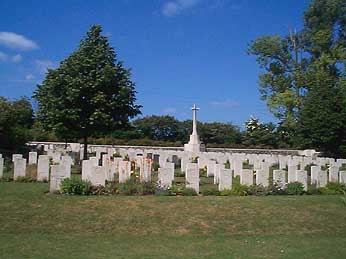
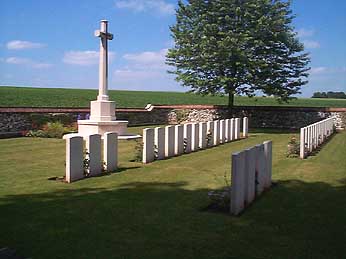
Hargicourt cemetery, Picardy, France - photos by Maryse Trannois, 2004
Minard travelled to France, and saw the white tablet of stone, with Charlie's name and age, among the endless rows, of white tablets of stone, with names and ages; and many others, containing fragments of men with no names at all. She wept, and she wept. And, later, she spent her life travelling the world, for cuttings, seedlings, seeds, books, and she acquired a vast knowledge of plants, perhaps praying that, one day, Charlie might emerge from some unknown and exquisite bloom. She became a firm friend of Charlie's sister, and together with their friends, they fought to shape a vision of the little Eden, to keep alive the memory of Charlie's ideals, and how many tens of thousands of others?
There is a third poem, or song, and it's called The Sydney Rose. Sonia Bennett has dedicated it to Minard and Charlie. It says:
She's the Sydney Rose,
The wild boronia of my home;
She blooms in beauty
From the beds of ancient stone,
A stone that's woven
With the wild tattoos of time,
She's my Sydney Rose,
The wild boronia, and she's mine.
Who was my lover,
Whose name is carved in stone?
We left our names here,
In the park the people own.
Who was the woman
Who loved me for evermore?
We left our names in stone,
Just by the Pearl Beach shore.
But, entwined here,
Our names live in the trees,
These wild boronias,
That she planted here for me,
The green she fought for,
Just by the Pearl Beach shore,
Our love that bloomed here
And that blooms for evermore.
And as you emerge from the cool, haunted, aromatic reserve of rain forest, onto the soft, sibilant sand of Pearl Beach, you will look up and you will see a long wave, hunting air and space, and carrumping into the scalloped stone.
And as the spray leaps skywards, a shadow appears, that looks like two lovers embracing for all time.
Produced by Denis Kevans and the Vinegar Hill band
Track 11 from the CD Shoulda Been A Champion Recorded at Down The Street Studio, Hazlebrook, NSW Australia
CHORUS:
Cueillons le co-quel-i-cot1, qui rougit dans le blé,
C'est le dernier sourire, la dernière pensée;
C'est le dernier cri de l'Anzac bien-aimé,
Dont le tombe nous garderons, n'oublierons jamais.
Lazily the South wind stirs the poplars tall;
Pools of shade and sunlight fleck the road between,
Where the soldier rested, ere the linnet call,
Saw the poppies dancing, blazing in the green.
Sullenly and sadly, over wood and wold,
Sobbed and throbbed, from Artois, the drums of sacrifice.
But the bird stayed singing till its love was told,
And the fields were kind with friendly eyes.
(CHORUS)
Onto battle pressing, through the little towns,
Did his fancy conjure sights and sounds of home,
Of the sheep far straying, strung across the downs,
Of the bells at evening, where the cattle roam?
Did he see a loved face smile into his own,
In a strange pre-vision, ere the close of day,
Ere the poppies withered, as the sun went down
Red athwart the red field where he lay?
(INSTRUMENTAL - ALL OF CHORUS)
(NEXT IS SUNG THE FOLLOWING MODIFIED ENGLISH TRANSLATION OF THE CHORUS)
When the poppy blooms in France, Jeanne and Marie say,
Gather the poppy that is reddening in the wheat.
It's for the good Australian, l'Anzac bien-aimé,
Whose memory we will guard, and never forget.
(CHORUS - AS FINALE)
NOTES:
Notes 1-3 are for non-French speakers.
1 "Cueillons le coquelicot" (Let us gather the poppy) is pronounced as "Co-yo le coq-kel-i-coe".
2 "Blé" (wheat) is pronounced as "blay"; "pensée" (thought), as "pon-say"; and "aimé" (loved), as "aim-ay".
3 "Tombe" (grave) is pronounced as "tom-beh".
4 Henry Pryce dedicated this poem to his brother and fellow soldier in World War One, Charlie, who was killed at Hargicourt, France, on 18 September 1918. Their older brother, Alan, was killed at Gallipoli in 1914.
Charlie was engaged to Miss Minard Fannie Crommelin who subsequently in 1940 established Warrah on seven acres of bushland close to Pearl Beach, on Brisbane Waters about 100 km by road north of Sydney.
In 1946, Miss Crommelin gave Warrah to the University of Sydney, with other possessions (including a valuable library) for the establishment 'in perpetuity of a biological and natural field station for research into and for the promotion of the study and improvement and preservation of the native flora and protection of native fauna'.
The bushland area adjacent to Brisbane Waters National Park (for which Miss Crommelin had actively campaigned) is an ideal site for studying both land and marine flora and fauna. Warrah is in constant use by students, staff and reasearch workers, including many visitors from overseas.
Miss Crommelin continued to live at Warrah, taking an active interest in the multifarious research and teaching activities until her death in 1972, at the age of 90.
Reference: David Branagan and Graham Holland (editors), EVER REAPING SOMETHING NEW, pages 174,175 and 225. University of Sydney Science Centenary Committee, 1985.
5 Denis Kevans' Master of Arts thesis at the University of Sydney (in about 1970) was entitled "The Poetry of Henry Weston Pryce". A copy of this thesis is held at the Fisher Library, University of Sydney.
6 "Coquelicot" ("The Poppy") is Track 11 on the 12-song CD, "SHOULDA BEEN A CHAMPION" by Denis Kevans and the Vinegar Hill Band (1997).
7 An unmodified English translation of the Chorus is:
"Let us gather the poppy that is reddening in the wheat,
It's the last smile, the last thought,
It's the last cry of the much loved Anzac
Whose grave we will guard, and never forget."