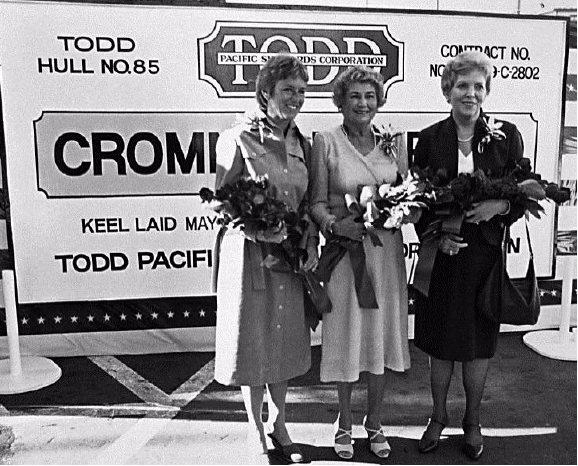
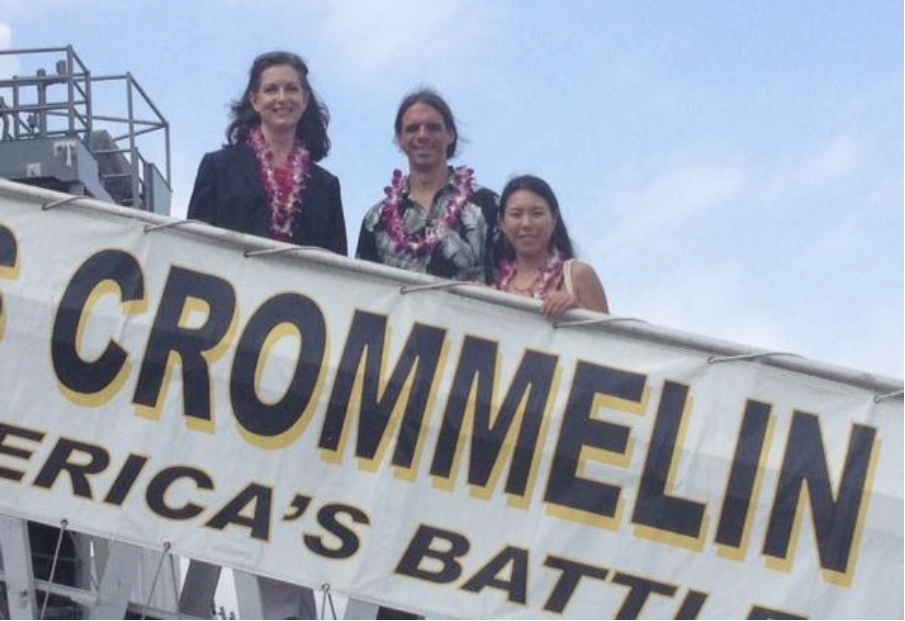
Katharine Crommelin Milton, PhD, is the daughter of John G. Crommelin, III, and lives in California
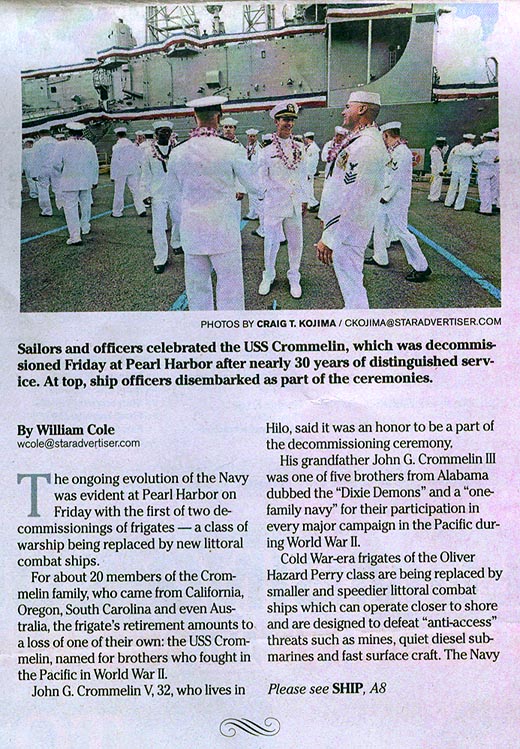
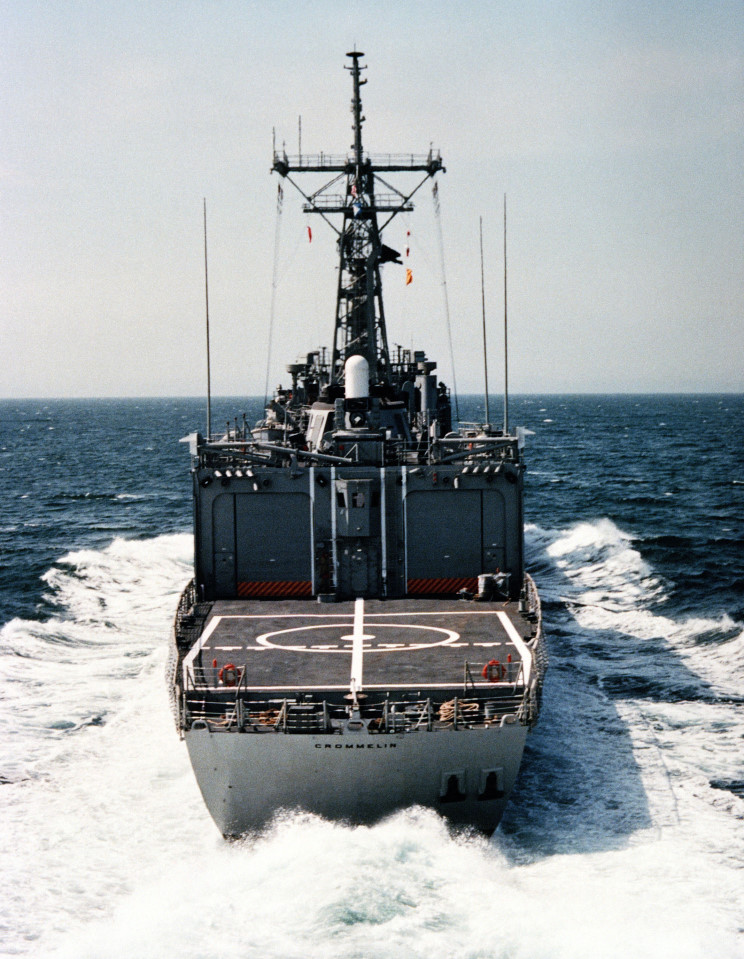
For more information on the USS Crommelin visit:
Link 1
Link 2
Link 3
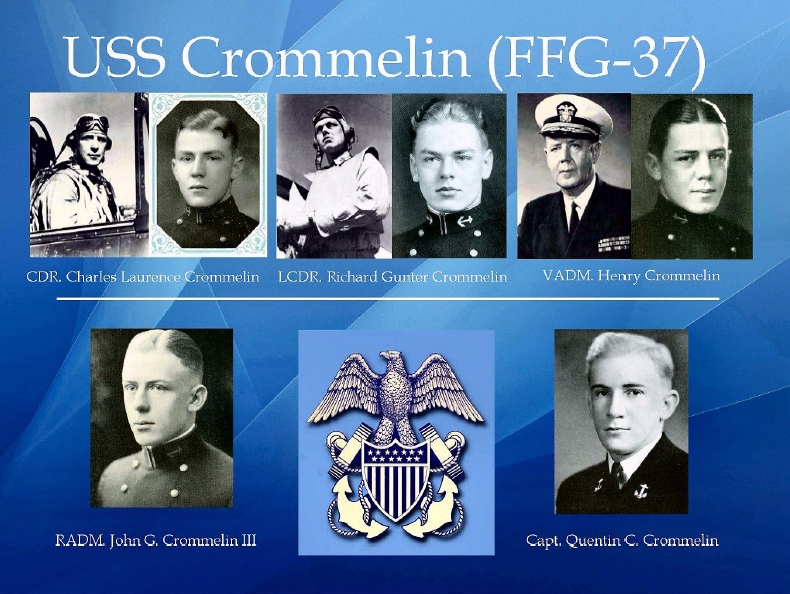
The Famous Crommelin Brothers
Vice Admiral Henry Crommelin, whose eyesight prevented him from becoming a naval aviator instead became a Surface Warfare Officer. During WWII he commanded the destroyers USS Fitch (DD-462) which escorted Atlantic convoys and took part in the invasion of North Africa. In November 1943 he commanded Destroyer Division 50 from the bridge of the destroyer USS Ringgold (DD-500) during the Gilbert Islands Campaign for which he was awarded the Silver Star Medal for his gallantry. His citation read in part: “Commander Crommelin entered the perilous and uncharted waters of Tarawa lagoon in the first assault wave to this important Japanese stronghold. Operating in the treacherous, coral-studded lagoon, he valiantly directed his command in the vigorous bombardment of shore installations and contributed to the success of his division in silencing several enemy batteries.” He earned seven other medals and awards including the Bronze Star for heroism as commander of the same squadron during the amphibious assault which resulted in the capture and occupation of Guam, Mariana Islands. He commanded the heavy cruiser USS Des Moines (CA-134) during her service as flagship of the Sixth Fleet, and was Commander Battleship Division 2. Admiral Crommelin later served as Assistant Chief of Naval Personnel and Chief of Staff to Commander Destroyers, U.S. Atlantic Fleet. He served as Commander of the Naval Station Newport, Rhode Island, until his retirement in November 1959.
Commander Charles L. Crommelin, who flew the Hellcat (Grumman F6F), was awarded a Distinguished Flying Cross for action as Commander of a Fighting Squadron in an attack on Marcus Island on 31 August 1943. The following November he was awarded a gold star in lieu of a second Distinguished Flying Cross for action as Commander of Air Group Five during the Gilbert Islands Campaign. The citation read in part: “While leading an important reconnaissance flight over Mille Atoll on 21 November…in complete disregard for his personal safety and in the presence of determined anti-aircraft fire, he strafed one plane and was maneuvering to attack the other plane when his plane was struck by a shell which exploded within the cockpit, shattering the instruments and severely wounding him. With no vision in his left eye, his right wrist broken, a sever wound in his right chest, as well as many cuts and abrasions on his face, arms and body, and with forward visibility through the cockpit enclosure almost zero, despite loss of blood, he brought his plane back over one hundred miles and made a perfect landing aboard his carrier…” After assuming command of Carrier Air Group 12 he was awarded the Navy Cross for extraordinary heroism during the first carrier force raids on Japan in February 1945. On 28 March 1945 Commander Crommelin volunteered to fly from another aircraft carrier to participate in pre-invasion strikes on Okinawa. He never returned from that mission.
Lieutenant Commander Richard G. Crommelin graduated from the Naval Academy in 1938 and was assigned to the battleship USS Pennsylvania (BB-38). He later served in the Pacific as a Wildcat (Grumman F4F) aviator aboard the first carrier to bear the name USS Yorktown (CV-5). Flying off the Yorktown he took part in the early raids on the New Guinea ports of Lae and Salamaua and shot down two Japanese Zeros during the Battles of the Coral Sea, for which he received the Navy Cross for extraordinary heroism. His citation read in part: “…for extraordinary heroism in operations against the enemy… Crommelin conducted a determined and decisive attack against an enemy Japanese four-engine patrol plane which resulted in the destruction of that plane, thereby preventing the detection of our forces by the enemy. His aggressive spirit of fearlessness in facing great odds to make eight successive attacks against six enemy fighters attacking our surface forces and harassing our anti-Torpedo Plane patrol resulted in the destruction of two enemy fighters and severe damage to several others. His conduct in these engagements was characterized by unusual leadership, prompt and sound judgment in the accomplishment of his mission and a complete disregard for his own personal safety.” A month later, in the Battle of Midway, he earned a Gold Star in lieu of a second Navy Cross for his disruption of an eighteen-plane enemy attack. He was put in command of Fighting Squadron 88 in August 1944. His brilliant career continued until May 1945, when two months after the death of his brother Charles, he was killed in action when his plane collided over Japan with another plane in his squadron in heavy fog.
Rear Admiral John G. Crommelin, III, nicknamed "bomb-run John", earned a reputation as a courageous and skillful naval aviator. He served as executive officer as well as air officer aboard the most decorated ship in naval history, the aircraft carrier USS Enterprise (CV-6). Crommelin was acknowledged by the crew as the "heart and soul of the ‘Big-E’”. He was awarded the Legion of Merit with a Gold Star, a Combat "V", a Presidential Unit Citation, a Letter of Commendation, and a Purple Heart. He was chief of staff aboard the carrier USS Liscombe Bay (CVE-56) when it was sunk by a torpedo in the Makin Island Campaign off the Gilbert Islands. Of her crew of 916, Crommelin was one of only 272 who managed to reach the deck after the initial torpedo impact and survive. In 1946, Captain Crommelin was given command of America's newest and most modern aircraft carrier of the time, the USS Saipan (CVL-48). After the war he challenged Congress by arguing against the "Unification Act" which sought to eliminate the Navy's aircraft carrier force. His actions initiated what became known as "The Revolt of the Admirals," which resulted in the saving of the Navy's air arm, but cut short Crommelin's career as an admiral.
Captain Quentin C. Crommelin, the youngest of the five brothers, graduated from the Naval Academy in 1941. Before receiving his flight school orders he survived two torpedo attacks from Japanese submarines while aboard the aircraft carrier USS Saratoga (CV-3). In a 1988 oral history interview he said, “That was a very happy, pleasant time, that year before the war. I was out there when the war broke out. We were just going into the port at San Diego when we got the news that the war had started. We really didn't believe it. Then we sailed to Honolulu--to Pearl Harbor--and got there a few days after the attack. It was really something. I know many people have told you about it, probably a lot of them were there at the time. Coming into the port we passed by the ARIZONA, which was awash, and it was one of the most moving experiences I ever had. Her deck was sticking above water on the side of the channel going into Pearl there. We gave passing honors: On the ships everybody came to attention, sound attention, and hand-saluted and so forth. The survivors on deck of the ARIZONA also gave us passing honors. It was as quiet as could be. Seeing that ship sitting on the bottom with just its few survivors standing and saluting us as we went by, somehow got to me. It was a shambles when we got into the port. There was oil about two inches thick on the water. There was an occasional body that people in small boats would pick up and bring alongside. At night we would take a bunch of men and rifles and go out and man the beach. There would be a sailor about every hundred yards with an old World War I rifle to repel invasion…” After receiving his wings Quentin flew the Hellcat and the Vought F4U Corsair. The war ended as his squadron of fighter-bombers embarked on the aircraft carrier USS Antietam (CV-36). He was promoted to Captain in 1958. After the war he enjoyed a long career in the Navy commanding Air Group 17 and the aircraft carrier USS Lexington (CV-16). After leaving the Navy in 1973 he retired to his farm in Alabama.