RETURN
Ammonets' Imprisonment in the Bastille (1686-1687)
AMMONET, protestant,
(Arrest ordered April 25, 1686. Imprisoned from June, 1686 to August 4, 1687)
- dragoons are sent to their house, 382;
- he flees to Mayenne, 405;
- summary of his evasion, 406;
- he is taken to Paris, 417 et 418;
- he appeals for his wife and children to be set free, 430.METTAYER (wife), protestant,
- she and her daughters are captured at Valenciennes, 382;
- they are taken to the Bastille, 405.Excerpts from the Archives of the Bastille
Arrest Record:
Seignelay to Mr. de la Reynie
5 January 1686
Since Ammonet has not converted (Ammonet, an elder of the consistory of Charenton, was obstinate), His Majesty did not see fit to grant you the exemption of dragoons to his house which he has near Tours, but he did approve an exemption for the wife of Ammonet, her daughters, and a sister who is a New-Catholic.25 April 1686
Mr. de Nointel is of the opinion that Mr. Ammonet was at Mayenne but that he has since fled from there, and that his wife is likely culpable in his flight. I send you the orders of the King to have her put in the Bastille and to have her incarcerated until she has caused her husband to return, and since Ammonet has apparently set off for Paris, I also give you orders to have him arrested if he can be found.

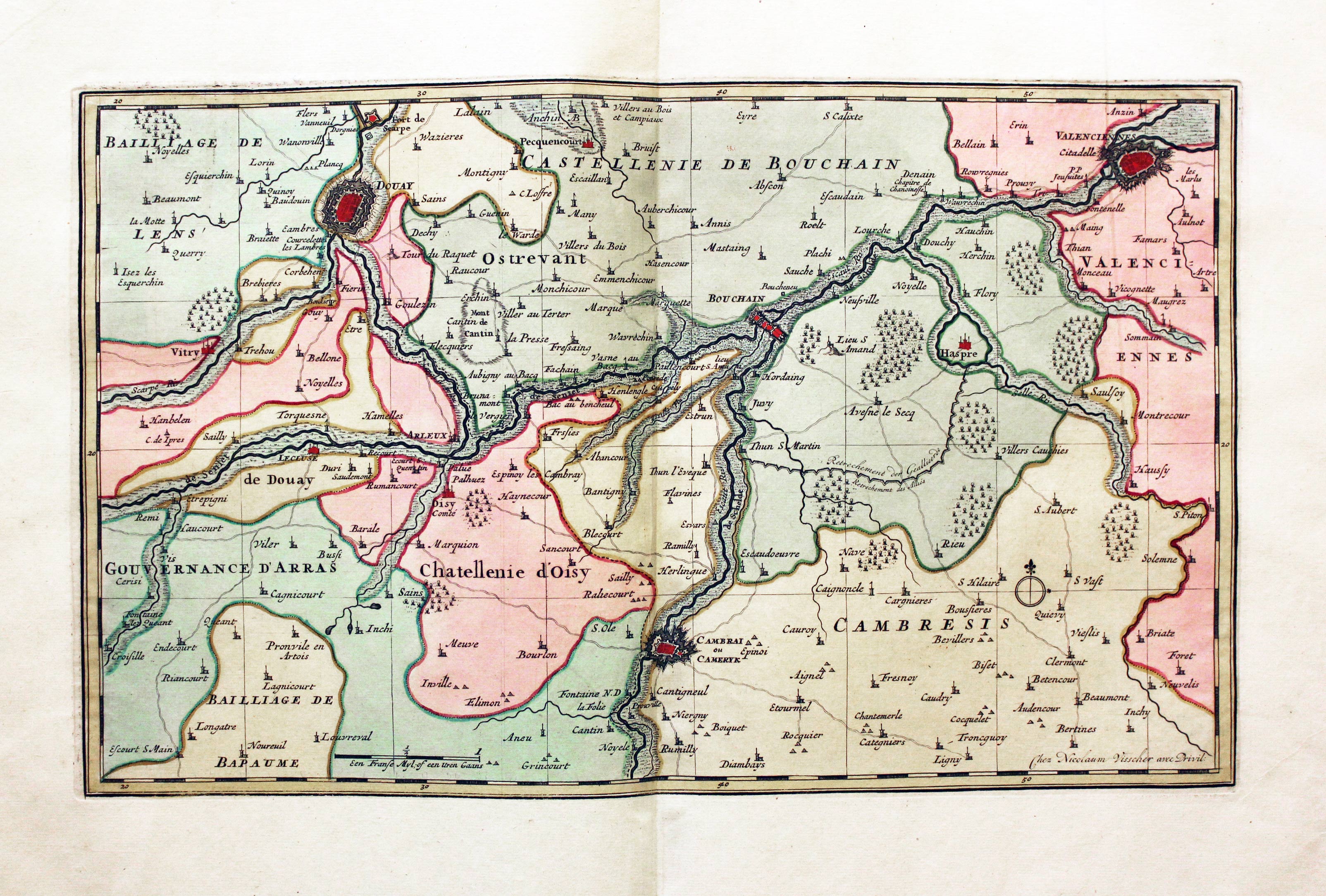
Map showing the towns of Douai, Valenciennes, Bouchain and Cambrai by Nicolaes Visscher, c.1690.
(Valenciennes at upper-right) Click to enlarge.Report
Ammonet, merchant of fine lace in Paris, is a native of Loudun. He apparently has no buildings; he is by reputation a very rich man and the value of his effects exceed 200,000 ecus. His brother [Francois, married to Jeanne Crommelin] who was also a merchant in Paris and in the same trade, established himself at London three or four years ago and he died there. We believe that he took along with him to England his family and about 400,000 liv. worth of effects. They continued to live there after his death.The wife of Ammonet, a former aristocrat, was arrested a few days ago at Valenciennes with two of her children. There is an accusation made against her at the request of the prosecutor of the King in which the husband is sufficiently implicated to have charges brought against him. We claim to have proof that he removed his effects out of the hands of his debtors; that they used false names; and that he conspired to take them out of the kingdom along with the departure of his wife. It is wished that the legal proceedings in this regard which were made in Paris be invoked upon the prisoners who were arrested at the border.
The same applies to several others who are absent from Paris and who have also been arrested. With regards to them and their families, it may be possible to do something to entice them back [to Catholicism]. If it pleases the king, this can be done through lawsuits, fear of punishment at law, or by the hope of pardon from his majesty.
Ammonet has been spoken to several times without much progress having been made with him. He is a man who has little brilliance outside his own business. He's stubborn about his religion and will be difficult to convert unless the embarrassing situation he has put himself into by violating the things that were forbidden don't serve to reduce him. And even if he is remorseful, it will be necessary to take precautions with him. Since he is guilty of a real fault, perhaps when charges have been levelled against him he will change his attitude.
Seignelay to M. de Reynie
10 June 1686
The King has given an order to have Ammonet brought to Paris, and he will presently be taken there.The wife of [Adrien] Crommelin has presently appealled to his majesty for the freedom of her husband. It would be necessary to see if he could be set free and if there will be some assurance taken regarding his future conduct.
Louvois to Seignelay
23 June 1686, Versailles
I believe I'm supposed to send you this word advising you that the merchant Ammonet, who has been a prisoner at Tournay, has left there to be transferred to the Bastille.Mr. Ammonet to Seignelay
From the Bastille, 20 September 1686
I have seen Mr. Chardon, by the permission which you gave me, who told me about the pleas which he had the honor of making to you on behalf of a poor tragic family. It is not me who is asking for my freedom. Because I am so guilty it is just that I suffer the punishment for my crimes, but please have compassion for a poor woman who is infirm and sick, and who over the past eleven months has spent more than eight months locked up in prison, and for the four poor orphans who sigh ceaselessly for their mother. The mother and children have no other sin than the carelessness of a father and husband who alone should be the victim. God will repay your charity which cannot be extended over more desparate subjects. And please forgive the liberty I take in writing this.[The order for Ammonet's release from the Bastille was given on 4 August, 1687.]
