The Rise and Fall of the House of Crommelin (Textiles)
Saint Quentin, France
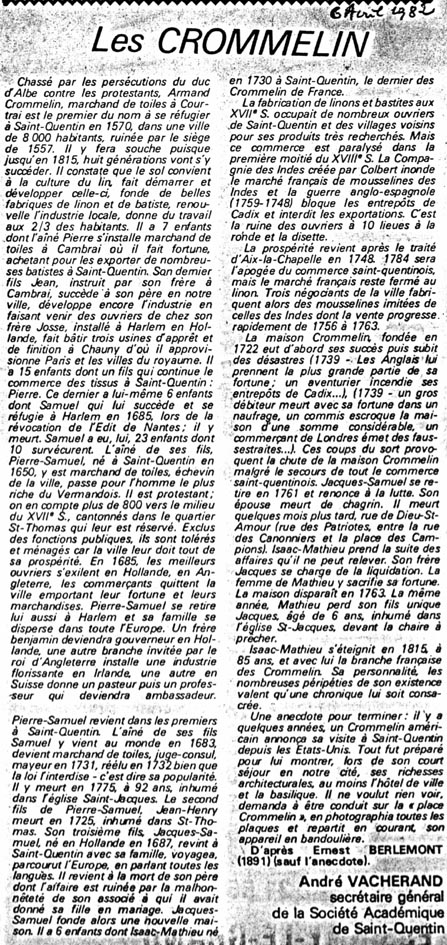
Translation of the above:
|
Fleeing persecution by the Duke of Alba against the Protestants, Armand Crommelin, merchant of textiles at Courtrai, is the first one by that name of those who sought refuge in 1570 at Saint Quentin - a city of some 8000 inhabitants devastated by the siege of 1557. He laid the foundation for the family there, where eight generations followed him until 1815. He noticed that the soil was suitable for the cultivation of flax; started to grow and develop it there; created beautiful linen and batiste; revamped the local industry, and provided work for 2/3 of the population. He had 7 children of whom the elder, Pierre, became linen merchant at Cambrai where he became wealthy while he purchased much linen in Saint Quentin for export. His last son, Jean, who was taught by his brother in Cambrai, succeeded his father in our town, developed the industry further by drawing workers from his son Josse, who was settled in Haarlem, Holland and had three factories built near Chauny from where he supplied Paris and other cities of the kingdom. He had 15 children of whom one son, Pierre, continued the cloth trade in Saint Quentin. The latter had six children himself of whom Samuel succeeded him and who settled in Haarlem in 1685, after the repeal of the Edict of Nantes. He died there. Samuel had 23 children of whom 10 survived. The eldest of his sons, Pierre Samuel, born at Saint Quentin in 1650 was linen merchant near the city and passed for the richest man of Vermandois. He was Protestant; there were more than 800 towards the middle of the 17th century, confined to the St. Thomas quarter, which was reserved for them. Excluded from public functions, they were treated with respect because the city owed them all of its prosperity. In 1685, the best workers were exiled to Holland and England. The tradesmen left the city, taking their wealth and merchandise with them. Pierre Samuel also moved to Haarlem and his family dispersed all over Europe. Brother Benjamin became governor of Holland. Another branch, invited by the king of England, moved a flourishing industry to Ireland. Another one was a minister, then a teacher and became an ambassador. Pierre Samuel returned to Saint Quentin. His elder son Samuel came into the world in 1683, became a linen merchant, judge-consul, mayor in 1731, and was re-elected in 1732 despite the ban, which speaks well for his popularity. He died there in 1775 at age 92, interred in the St. Jacques church. The second son of Pierre Samuel, Jean Henry died in 1725, interred in St. Thomas. His third son, Jacques Samuel, born in Holland in 1687, returned to Saint Quentin with his family, having traveled all over Europe, speaking all the languages. He returned at the death of his father whose business was ruined by his dishonest associate to whom he had given his daughter in marriage. Jacques Samuel then built a new house. He had six children of whom Isaac Mathieu, born 1n 1730 at Saint Quentin is the last of the Crommelins in France. In the seventeenth century the manufacture of linens and batiste occupied many workers in Saint Quentin and from neighboring villages, for its products were much in demand. However the trade became paralyzed in the first half of the eighteenth century. The Compagnie des Indes, established by Colbert, inundated the French market with Indian chiffon, and the Anglo-Spanish war (1759-1748) locked out the warehouses of Cadix and prohibited all export. That ruined workmen in a radius of 10 miles. Prosperity returned after the treaty of Aix-la-Chapelle in 1748. The year 1784 would be the peak of commerce of the inhabitants of Saint Quentin but the French linen market remained closed. Three firms in the city then manufactured imitation Indian chiffon of which sales increased quickly from 1756 until 1763. The house of Crommelin, founded in 1722 had its first success soon after the calamities. (In 1739 The English took away a large part of their fortune with them; one adventurer burnt down his warehouses in Cadix. In 1739 a formidable debtor died with his fortune in a ship-wreck; a clerk swindled the house of a considerable sum, and a merchant from London committed fraud). Such deeds provoked the collapse of the house of Crommelin despite the assistance of all the Saint Quentin merchants. Jacques Samuel Crommelin retired in 1761 and gave up the struggle. His spouse died of grief. He died several months later on the rue de Dieu-St. Armour {street} ({street of the} rue des Patriots, between the rue des Canonniers {street} and the place des Campions {Place}). Isaac Mathieu took over his business, which he could not recover. His brother, Jacques, took charge of the liquidation. Mathieu’s wife lost her fortune. The house ceased to exist in 1763. In the same year, Mathieu lost his only son Jacques at age 6, interred in the St. Jacques church, in front of the pulpit. Isaac Mathieu passed away in 1815 at age 85 and with him went the French branch of the Crommelins. Their personality, the many changes of their existence are worth a chronicle to their dedication. By Ernest Berlemont (1891) André Vacherand
(Translated by Patrick Serné, Penticton, Canada, January, 22, 2002) |