Chapter 02
 Page: 12-19
A WITNESS to the FRENCH REVOLUTION
CHAPTER 2
12
The Two Assemblies of the Notables
The causes which I have just described made all the administrations languish in an alarming way. It was no longer possible to discharge even the interest on the loans. Necker, Fleury and Dormesson had exhausted every resource. The plight was such that bankruptcy appeared inevitable.
To head off such an eventuality an Assembly of Notables was convened in 1787 to deliver their opinions and advice. This assembly was majestic. It consisted of princes, the nobility, the high clergy, judges, deputies of state, and even the heads of municipalities were there. Calonne was made the convenor.
He developed in detail the dreadful state of the nation's finances, proving that it no longer had any credit. He ended by proposing a territorial tax whose distribution was to be done in an exact proportion, and without exception.
13
A general outcry was heard. Sacrifices were needed but nobody wanted to make them. The fruit that Calonne drew from all his eloquence was his dismissal and a general curse. The assembly of notables adjourned after having put on a day of grandiose pompousness and majestic non-productivity.
The general administrator of finances was appointed because this portfolio concerned the privileges. Loménie de Brienne, archbishop of Toulouse, was named head of the council of finances. He had a systematic spirit; his character was keen, a regal bearing, and the circumstances required a flexible minister. But he did not serve the royal authority well. He compromised the French monarch and only made blunders.

Etienne-Charles Loménie de Brienne
(1727-1794)
[Archbishop of Toulouse, appointed Minister for Finance in 1787. He came into conflict with the Parlement of Paris and the nobility whose privileges were being threatened. He had to withdraw himself in 1788.]
A man of spirit, speaking easily especially with regard to the labyrinth of finance, he was known to be remarkable. But in the course of his ministry he showed only the most audacious impertinence. There is a distance between a fine talker and a deep thinker. Brienne began by rescinding the corvées.
14
He allowed the export of grains at a time when food was scarce and thus contributed to the food shortage. He levied six million kinds of revenue. He undertook the same projects of Calonne which he was vigorously opposed to before. Together with the king he formed a branch of justice which took place under protest from the judiciary [parlement]. Loménie de Brienne became Prime Minister; Lamoignon had just replaced Miroménil: they intended to curb the power of the courts by the creation of a plenary court.
The Minister of Justice worked there covertly and Desprémesnil knew it. Having bribed one of the workmen of the royal printing works who revealed the secret, he operated a coalition between all the courts. The court of Paris was exiled to Champagne Troyes but was recalled rather promptly.
The king held a second branch of justice to obtain the registration of various ordinances and particularly a second twentieth. The duke d'Orleans, from whom hatred fomented vigorously, made opposition to this registration and was exiled to Rincy.
The assembly of notables and the projects of Calonne had put the kingdom in great turmoil. The brothers of the king were
15
insulted, and everyone was demanding the convening of the Estates-General. But neither Loménie nor Lamoignon wanted this last resort to take place. In order to move away from this option, they always promoted the idea of a plenary court.
It would consist of the chancellor of the supreme court of Paris, of the princes by blood and others. The captain of the guards of service was even to be entitled to vote. His duty would be to carry out the checking, recording and publication of all the edicts and ordinances, declarations, letters of patent, etc., to the assembly of the Estates General.
This plan, however, was not popular and Lamoignon knew it. He was advised by the king to declare purely and simply his intentions, and this bad counsel had its effect. The Parliament protested again and this was followed by the closing of the courts, the suspension of all laws, an uprising in Dauphiné, the consternation of the people, and a general tax revolt.
The project of the plenary court was then suspended. The Prime Minister, absolutely confused and bereft of ideas for administration, clumsily appealed to the nation. And this is what spawned the birth of hordes of inflammatory writing.
16
Mister de Brienne, you made one major mistake: Non erat hic locus. You thought you could unleash all the winds and not create a violent storm! The minister recognized his mistake. Incompetent to face the storm he had unleashed, he left the ministry altogether and withdrew to Italy thus leaving the king exposed to the fate of the events that followed. Brienne earned the reputation of an imprudent minister.
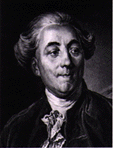
Jacques Necker (1732-1804)
[Director General of finances in 1777. He had to resign in 1781 but retained an immense popularity amongst the Third Estate. Recalled in 1788. His initiative on July 11, 1789 started the disorders of July 14. Recalled on July 16 he could not control the events and left his position in September 1790. ]
Necker was then given the helm on finances. This appointment alleviated the insurrection in Dauphiné against which troops had been sent. The title given to Necker was that of director of the royal treasury. Clugny was made general controller but he died and Taboureau, an excellent man but without energy, succeeded him. This Genevan [Necker], not wanting any obstacle to his projects, required an unfettered freedom to pursue them and obtained it:
a) despite the objections of the clergy against a Protestant;
b) despite the objections of the nobility which saw in this minister nothing but a banker;
c) despite the caste of the farmers-general who feared the methodical order of a man accustomed to exactitude;
d) and much more still, the enormous workload demanded by Turgot.
The senior prior even carried complaints to old Maurepas who replied with his
17
usual irrascibility: "If the clergy wants to undertake to pay the nation's debts, I assure you the king will consider a new director of finances".
Necker, born a plebeian, had the confidence of the multitude. The experience of the last centuries had taught him that, at all times, the court had dominated the national assemblies and, since he was a junior worker, he had no doubt that the Estates-Généraux, while giving heed to him on matters of finance, did not place him in the rank of great men. However, wanting to put his responsibility to the test, he believed he had to institute a new assembly of notables in order to consult them and prepare the first remedial measures.
The notables were assembled a second time in 1788. There was much dispute. Each body showed its spirit there, and the eloquence of the minister failed against all the diverse opinions that could not be reconciled.
One question in particular animated the three orders [nobility, clergy, commoners]: Will the deliberations be decided by 'head' [per capita] or by 'order'? The parlement claimed the form of 1614, but the Third Estate opposed it. In 1614, the three orders each had equal representation, and the result was that both
18
higher orders, by joining forces, could always arrive at a decision that favoured them. Thus the Third Estate asked for a representation equal to that of the two other bodies combined.
Monsieur, the brother of the king, declared in favour of the Third-estate but the Count d'Artois had a contrary opinion. Then appeared a flurry of very abrasive writings, both for-and-against, which foreshadowed that the Estates-General would be very stormy.
Finally the king, weary of disputes that weren't leading anywhere, assembled his council on December 27, 1788, to examine the question. He then made it known:
a) That he wanted nothing to change regarding the institution of the three orders which would be called to deliberate separately;
b) That the number of deputies of the Third-estate would be equal to the number of the deputies of the other two orders.
c) That the Estates-General would be convened on May 1, 1789;
d) That in each baillage the elections would be done on the basis of population and the impositions (tax base).
Far from criticism and protest against this decision, it was accepted with general approval. Thus the clamouring of
19
the nobility and clergy against the proclamation of December 27 owed their existence only to some stubborn and unruly spirits.
Mr. Necker had a plan to stop it; it is hardly possible to doubt it. His plan could have been
a) to meet with the third-estate;
b) to have it pay the clergy and the nobility the deficit which, according to one estimate, amounted to 56,150,000 liv. per annum. [See the speech of Mr. Necker. Calonne had reckoned the deficit to be much higher.];
c) to take the disagreements from the three orders and place them in the hands of the king for arbitration;
d) to popularize themselves by the discharge of some taxes, a measure that would hasten diminishing the debt load;
e) and to control the kingdom, as Richelieu had done in the midst of his enemies.
In truth, this policy was quite visible and it appeared that Mr. Necker knew his stuff.
[Background Note:
The War of American Independence greatly increased the national debt of the two principal combatants, Britain and France. The French debt after the war stood at over 4 billion francs, the British, expressed in French money, at about 6 billion. Per capita indebtedness was much higher in Britain, which had less than half the population of France. Annual income of the two governments was roughly the same. In both countries half or more of it was required for debt service. Yet the British were successfully to triple their debt by the time of Waterloo while the smaller French debt overwhelmed the monarchy.
In France, before the Revolution, there was no "national" debt at all. No representative body had ever accepted it as a public obligation. The debt was the king's affair, and its true dimensions only became known after the American War when two successive controllers general, Necker and Calonne, found it impossible to increase either loans or tax revenues in sufficient amount...
The difficulty in France was that while there was a good deal of wealth in the country, the tax revenues could not be increased because the poor were already taxed to the utmost, while the rich and even middle classes largely escaped. Nobles were exempt from some taxes on principle and from others by influence. Wealthy commoners benefited from special arrangements. The Catholic church owned between 5 and 10 percent of the real property of the country; it presented the government with a periodic "gift" in lieu of taxes, which was less than taxation would have produced.
Whole provinces benefited from special concessions made as long ago as the fifteenth century. Subjects were protected against the tax collector by their special rights or privileges. The monarchy, if the greatest in Europe, was still a makeshift confederation of towns, provinces, regions, ecclesiastical establishments, and social classes, each trying to accept government on its own terms. A fiscal crisis automatically turned into a crisis of political structure.
- Source: "The World of the French Revolution" by R.R. Palmer, p50-51.]
|

 Return to