Recollections of a Pioneer in Australia
Part 3
George Whiting Crommelin (1845-1905)

Part 3: 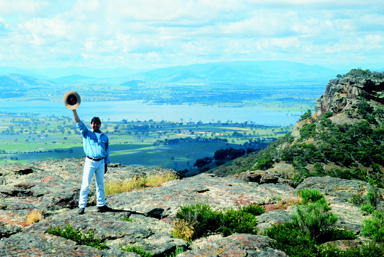
Albury on the Murray River Image source Destination NSW - Albury James then went to Albury where he had the billet as Stock Inspector. I went and stayed with him at the time when the Wodonga Railway was opened. I went to the Ball celebrating the event. Five hundred people were there, some from Melbourne and Sydney. It was beautifully decorated with flags and there was a string band from Melbourne. One lady wore a dress which cost some five hundred guineas in Paris. It seemed like a spider's web of gold over a pink skirt. We had to arrange to meet our partners and friends under certain flags. Dancing was held in the goods shed while supper was served in part of the shed and platform covered with tents, etc. decorated with beautiful ferns. The Governor from Victoria was there too. 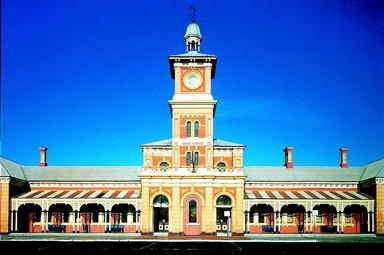
Albury Train Station [The first known settlement of Wodonga was in 1835 when pastoralists established an outstation in the area now known as Bonegilla. The following year "Wodonga Station" covering some 41,000 acres, was settled on the south side of Wodonga Creek by the Huon family whose origins were French. The area grew rapidly with many squatter runs being established and the discovery of gold in the district in 1850. In 1851 the separate colonies of New South Wales and Victoria were defined with the Murray River becoming the border. Hence Wodonga became part of the new colony of Victoria. By 1869 the population had grown to 500 and the first Police Station and Court House were erected. The Rail line from Melbourne reached Wodonga in 1873 and in 1876 the Shire of Wodonga, covering an area of 90 square miles, was gazetted and the first Council elected.] When James got better I went on to the station of Mr. Emsley, a friend of my Father, and had a holiday there. Soon afterwards the Owney Goldfield broke out six miles from Mr. Emsley's place. My Father, one of a Syndicate taking up a lease on the Lee River, made me manager of it with two old Beechworth miners. We put down a shaft but it did not turn out to be a payable goldfield. After four months I left and went to Mr. George Green's Tumur Station, a few miles from Tumbarumba. I was some considerable time taking up selections for Mr. Green. From there I went to Mr. Robert McMicking's station "Manners" and engaged with him for a job of droving. I had to go from there to Mr. N.P. Bayly's place at Havilah Station to purchase for Mr. McMicking two hundred rams. I stayed there one week to pick the rams, and then started droving to Mr. McMicking's Station "Cashmere" on the Ballon River - a few hundred miles. I had a bad journey. Part of the time I was by myself because I could not get men since there was a rush to the Queensland Goldfields. I did, however, have a black fellow part of the time. We had six weeks of constant rain. After a tiring, weary journey I arrived at "Cashmere" with a black fellow showing me the way through the bush. I stayed there a little while and, getting a horse, I rode to Narrabri where I sold horse, saddle and bridle and took the mail coach to Newcastle and the train to Sydney. From there I went to Melbourne to settle with Mr. McMicking who was there on business. He also had big business undertakings in Melbourne. From there I returned to Albury. At that time the gold diggings broke out at Tumbarumba. I was manager of the "Fortunates" and the "Marion" Mines run by a Sydney Syndicate, my Father and Randolph Nott being in the Syndicate. Tumbarumba at the time was full of people from all parts and claims were being staked in all directions. William Buck was my head man along with Jack Naylor. We commenced to put in a large tunnel in the surface hill, six feet in the clear. We ran it 185 ft. with cross drive 160 ft. We worked night and day with two shifts of four men on each shift. It was all basalt country. Norman's Public House was the principal house then and it was a lively place - a rowdy fighting place. After working the mine for several months at great expense, we came upon wash dirt, but it was not payable. Too much work was attached to it and it cost 11/4d. per foot to tunnel. It was let by contract. Since we had taken the contract, we simply gave it up. Not far from us there was a big swamp where there was a number of prospectors. Two brothers named Jackson had a claim there which they said was paying them very well. Our company thought if this was true it would pay to drain the swamp. They wanted to sell their claim so my company sent me to inspect it. I had suspicions and hid myself in the scrub to watch. Soon after daylight they came along laughing and talking and got up to the claim where they had ready a nice heap of wash dirt. Looking all around they saw no one. Taking a bag of gold dust they thoroughly salted the heap. I crept back and wrote my report. The Company did not buy. I was dining next day at Norman's with about forty or fifty people of all classes when J. asked me in a very important way if I had reported on his claim. I said, "Yes, I had." He said, "Well, how did you report?" I replied, "You ought to know, having salted it so well." He said, with a lot of oaths, "You're a liar." I sprang at him but we were separated. Then we went into the street. He commenced taunting me and said I didn't know how to hold up my fists. I responded by knocking him clean down, hitting him right in the eye. He was up like a shot again and came at me. I warded him off, and just then the constable came by and enquired what the row was all about. He said I was right, but if there was any more fighting he would take us both in charge. So we left off. I then purchased for myself a large alluvial claim with a big race to bring on the water. I worked for a long time there by myself, getting a good share of gold. Then it ran out so I gave it up and returned to Albury to my Father at the Rose Hotel. I then took charge of Brown's Springs Shed for Thomas Mate Esq., Mr. Craig being manager. As I gave satisfaction, Mr. Mate gave me charge of Tarcutta Shed, his son Thomas Mate being manager. I then went to Sydney, thinking I would try droving. Through my Father I was introduced to Langbrough Parker Esq. of Bangate Station. He was in Sydney buying horses and drays (two teams) with six horses in each team, to take loading to Bangate. He engaged me to travel with the teams. I drove one part of the way. It was a long tedious journey. We took the train from Sydney to Balaramine and made a final start from there. I remained some time at Bangate, stockriding and mustering cattle. I got tired of that so I took a job at droving a mob of cattle under Mr. Jones for Maiden Hill. Clarke took them to St. George's bridge, a long and tiresome journey and great work with cattle for water was scarce. We made delivery of them at St. George. I rode back through Narrabri to Sydney by myself - a lonely, dreary time. 
Vicinity of Narrabri Camping out one night I was sound asleep when just before daylight I woke with an awful yell. Just by my head was a huge dingo. He was calling his companions thinking I was dead, I suppose. I sprang to my feet. He trotted off a little way and sat down and looked at me. Part of that day some of them followed me, but I got to Sydney alright. 
Australian Dingo - Click to enlarge 1877 From there I went to take charge of Eureka Station on the Barwon, six miles from Walgett. The owner was Frederick York Wollesley, brother of Colonel Wollesley. At that time Mr. Wollesley was inventing the shearing machines that are now so much used in the sheds. [In 1877, Frederick Wolsley started to experiment with mechanical shearing devices, having decided that the existing method of hand shearing was inadequate and needed a major overhaul. Patent for this machine, developed in his blacksmith's shop on his property Euroka, was granted in March of 1877. The machine was a huge success, spreading rapidly throughout the whole country. Relics of this era can still be seen on the property.] It was quite a new station, having only two bark huts. Mr. Wollesley and I lived in tents for a few months until the house was built - and then it was only a wooden bush house. He was turning it from a cattle station to a sheep station and I had to superintend building five tanks for stock. There was a bookkeeper, Mr. Brain, and myself, a married couple (the woman to cook, and the man to work on the place), one white stockman and the horse breaker, Tom Williams, a half-caste 6 ft. 1 in. in height, the best horseman ever heard of - Mr. Wollesley set great store on him. The horses were a splendid lot but great buckjumpers. One notorious horse was called "Terror" - light brown with a black stripe down the back, low set, powerfully made, and well bred. No man on the Barwon could ride this horse. The next station, Dangarie, challenged his stockman, Dodd, to ride "Terror". Mr. Wollesley had a lot of Melbourne gentlemen over to watch, but Dodd got thrown. Williams mounted "Terror" and rode very well. Mr. Wollesley was so pleased with the exhibition, he said it could not be beaten in all the world. He told Williams to choose any horse on the station he liked as a present from him for his wonderful riding. So Williams chose his stock horse called "Hercules", dark brown, a pretty beauty and a wonder at cutting-out in drafting. We did a great deal of this kind of work. One day when we were building the tanks, a fall of earth fell on one of the men. We could not move him, for it was too hot and he had to remain in his tent. I helped nurse him. He died on the third day. He was buried in Walgett but no clergyman lived there so the poundkeeper read the burial service. It was a sad event altogether. 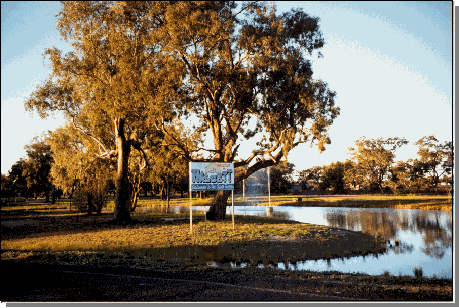
Walgett Map The disease, sandy blight (Ophthalmia), was very prevalent at that time. Mr. Wollesley got it and I helped nurse him too. Mr. Andrews of the adjoining station took Mr. Wollesley to his home. Mr. Rosenthal, a Sydney oculist travelling there, treated Mr. Wollesley and cured him. Then Mr. Wollesley went to Melbourne. Some time later we (Mr. Brain and I) were living in the new house when I too came down with Ophtalmia and became quite blind. The hot water from my eyes burnt my cheek. We tried everything until Dodd told me soap was the best. So I made a good lather and it was wonderful how it soothed me. I got a little better, but had to leave on account of my eyes. The doctor in Walgett said if I remained there I should go blind. Just at this time I got a telegram stating my Father's death (1877). [Thomas Lake Crommelin died at Sydney 7 April, 1877. His warmhearted, gentlemanly nature is glowingly described in C. Fetherstonhaugh's book, "After Many Days."] 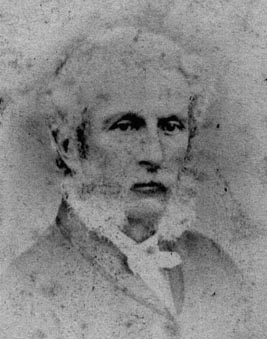
Thomas Lake Crommelin (1805-1877) I rode seventy miles that day in the heat, taking the mail coach from Castlereagh. There the landlady gave me some golden ointment which had a wonderful effect. When I reached Sydney where my Father had died, I was too late for the funeral. I stayed with Sir John Bowie Wilson at whose home my Father died and got my eyes thoroughly well. One day going down Pitt Street I met H.T. Edwards and asked him if he knew of any job of droving. He had just left John De V. Lamb who was going to Warialda to Mr. Sloper Cox's Station. [John de Villiers Lamb (1833-1900), son of Commander John Lamb, R.N., was a squatter in the Mudgee and Liverpool Plains districts.] 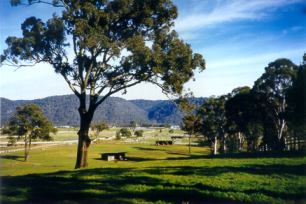
Castlereagh Mr. Lamb was executor for the estate and there was a terrible drought there and all the stock had to be moved. I went to Messrs. Lamb & Knock's office and they engaged me to start in about a week's time and to get someone else to go under me. So I got William Davis, a friend, to come. We had two waggonettes made in Sydney, with harness etc. and forwarded to West Maitland. Willie and I took train to Maitland and stayed at a Hotel about eleven days, buying horses, sixty in all. We engaged a cook, a man to take complete charge of the horses and fourteen other men, and got others on the station. We started from West Maitland one fine day with all the men, provisions, pots, pans, etc., Davis driving one waggonette and I another. Sometimes I would ride and let a man take the reins. It was a great party and a great undertaking. Arriving at the Station in due time, we found all well and Mr. Lamb was there to meet us. He was very pleased with the men, horses and everything in general. We commenced to muster the cattle. We mustered first 1000 head. Davis started with those, taking ten men and one waggonette. I started a few days later with the same number of cattle, men, etc. After travelling a few days I received a telegram from Lamb & Co. telling me to push on and overtake Davis and to take charge of his cattle as he was not doing right. He had received bad reports about him. I took delivery of Mr. Davis' cattle, making 2000, and had Willie Dawson, a friend, to help me. I put Dawson in Davis' place but kept the cattle in one mob at night and cut them out in day time. It was wonderful how the same cattle would fall together with the same leaders, same stragglers, etc. We were nine months on the road and had great trouble with the cattle. Mr. Davis spoilt them - they were what you call 'stampede cattle'. One night we lost seventeen head killed and wounded in a wire fence. Others went twenty-five miles on the next day - I think a kangaroo had startled them. We travelled to grass and water the cattle and to sell them as we went on. We went down to Hay and turned back to Wagga Wagga, selling the last of them at Young. While we were coming down the Bland, the drought broke suddenly and there was a big flood for three days and three nights. We camped the cattle on a little rise which was under water and had to build a bank around to keep the water from going into the tents. The hair came off the cattle's legs to their knees from standing in the water. The bland is a level country for miles and miles so we could not get out of the water. When the flood went down we swam the cattle across to Cowal Lake where we stayed for a few weeks. Mr. Donkin of Cowal Lake bought four hundred head and gave us a paddock to keep the others in to rest. Mr. Lamb met us at Cowal Lake. The whole country was under water and all mail traffic, etc. had stopped. We went from there about twenty-five miles to Grenfell; Mr. Lamb had an important telegram to send to Sydney. Grenfell was the nearest telegraph office and he did not know how to get his message away. He thought it too risky to ask anyone. I offered to go, but he did not like it. I had to ride about nine miles through water, touching land only here and there. Twenty-seven times I had to swim my horse. As I did not get to Grenfell that night, I stayed at Mr. Gibson's station. They were very kind to me and were friends of Mr. Lamb. I got to Grenfell the next morning. The people could hardly believe I came from Cowal Lake as they could not get anything through. Of course my horse was a beauty and a lovely swimmer. Some teamsters that were camped on a river tried to stop me crossing by waving me back and were very surprised to see me land safely on their side. The people at Cowal Lake were terribly anxious about me. My ride was considered by everyone to be a very desperate one. I'm not boasting (and I don't mean to), but am telling the truth. We went from there to Wagga Wagga; got a large paddock there and turned the cattle in after selling a goodly number. I stayed there ten days and was not at all well. Then I went to Sydney to see Mr. Lamb, leaving Dawson in charge. He had about four hundred head. He sold them and came on to Sydney where we settled up affairs. Mr. Lamb was very pleased and gave me a very good testimonial. We sold the horses for more than we paid for them. The whole expenses for the nine months was 780 pounds. I sold one pair of waggonette horses (dappled greys) for 40 pounds. I stayed a few weeks in Sydney and came to Monaro, Bibbenluke, H.T. Edwards manager, visiting for only a few days. Then I went to Little Plain, Mrs. J. Nicholson's station, and was there for some time. I took a mob of cattle with Mr. W. Newton to Yass. We had a black boy, Dick, with us. Completing a good trip, we sold our cattle well and came back. Newton joined me in possum-skin buying and we did well. After being there some time I went to manage Aston Station under Mr. Robert King who lived in Sydney. I still kept up the fur business and used to send a great many pelts in bales to England. I had an agent buying in a number of cold districts, even to Yass. Then I got married, but the fur business went bust, some of the agents being very unscrupulous. We had two little girls born at "Aston", Bombala, NSW. Later I bought a place for myself at Craigie and called it 'Finchley' after my Father's old home in England. There, when my health failed, I sold the place and went to Bega. |
