The Memoirs of Isaac Mathieu Crommelin |

|
01 - My Introduction to St. Germain-en-laye 02 - Bureaucracy During the Revolution 03 - I Suffer Losses 04 - Bureaucratic Lunacy 05 - De Noailles Experiences Foul Play 06 - My Influence Helps Save Lives 07 - My Plan to Save Mme DuBarry 08 - Ingratitude Hurts 09 - I Meet Robespierre 10 - A Hailstorm Ruins Me 11 - I Save the Forest of St. Germain 12 - An Old Lady and a Tree 13 - In Defense of Shrubbery 14 - Accused of Favoring Aristocrats 15 - Foiled Entrapment |
16 - I Take Custody of Art Treasures 17 - My Kindness Repaid By Hostility 18 - The Wood of St. Germain 19 - State-Approved Plundering 20 - I Am Arrested 21 - My 'Crimes' 22 - Aiding Prisoners at Récollet Convent 23 - Lifting Morale 24 - My Name Is Called 25 - Making An Inventory 26 - Merriment in Prison 27 - Prison Intrigues 28 - We Bribe Our Jailer 29 - The September Massacres |
Without pretention and lofty inheritance, I envy not the palaces of the mighty. While nobody weaves purple robes for me, I am content with my lyre and little spirit. However poor I am, and while the rich look for more, I ask for nothing of God - neither a larger fortune, more importance, nor even a powerful friend.

Saint Germain: Ruins of the Chateau Neuf, 1878
My Introduction to St. Germain-en-laye I arrived at Saint Germain-En-Laye, where I found absolutely no vestige of state control. The municipality received me very coolly because it sensed in my presence a threat to their usurped authority. The district however, having no such claims, was not irritated to see a manager. My beginning was rather unpleasant, however. I was in charge of taking an exact inventory of the forest while the chief administrator of the region did not want it. Some days therefore were spent with opposing views. I decided to write him, and to have ample time for explanation I gave him the option of receiving me at his place, or to have him come and visit me at my home. As it turned out, he invited me to dinner and we smoked contentedly one after the other. Most of our differences were thus resolved through sincere mutual understanding.
I found in Mr. Baumier (the chief administrator) the candor, friendliness and good faith which characterized the gallant man. I cultivated his friendship and I shall endeavour to cultivate it for the rest of my life. Nothing will please me more than to have occasion to prove to him the value which I attach to his esteem. But in general I must caution strangers to be wary of the friendship of the folks from Saint Germain.
(158) Bureaucracy During the Revolution
I spent some days writing circulars and gathering information, then one morning two municipal officials arrived, one whose name was Prévost and the other, Quillet.They began by proposing to me the destruction of a large building belonging to Mr. Guy, a man who even the intendants of the feudal lords took to be their model - a man well known for his talents, his fortune, his equity and impartiality, his modesty and virtue. The reasons given by these municipal officals seemed absurd to me. They said that the building blocked the sun from neighbouring houses. Then they told me (somewhat sheepishly) that there was a lawsuit between the municipality and the owner based on an abuse of authority. This was true because the building, built for the sake of a single individual, is in the middle of a street and masks many houses. I replied to these gentlemen that the object of my mission was to preserve and not to tear down. Furthermore, by their own admission there was a lawsuit in progress. Although the outcome of any lawsuit is uncertain, it would seem proper to await the judgment, and of course they had the liberty to challenge that decision.
I then asked them if they spoke in their own interest or if they were put up to it by the municipality. They declared that they had come on behalf of the people. "In that case, gentlemen, there is a public consideration, and I ask that you communicate it to me." Then the piston of hatred went into full motion and manifested itself in slanderous newspaper articles of the time.
I looked long and hard for some resolution to the situation because the wood buyers and other debtors were not present and even the creditors weren't there. The waters were troubled and everybody wanted to go fishing in it. The idea came to me to make excessive demands. Then we produced accounts and this was the key for which I had been looking. "Bring me your titles," I said to the creditors. "Take heart; I promise to write only in cooperation with you."
(159)
We went forward and I kept my word.I Suffer Losses My actions first caught the attention of the Premier. He was amazed at my work and expressed his satisfaction in the most flattering terms. "You cannot do this job," he wrote me, "unless you get yourself an assistant for as long as you want." The fact is that when the state control took up the civil list, the order which I had established was continued. I took two clerks who, accommodated and fed, cost me a great deal. Then I needed land surveyors, workers and guides. Always on the move during the day, I drafted at night and my two clerks were hardly enough to do all the copy work. It was necessary, besides, according to the order of the Premier, that I purchase all the suitable furniture for the creation of an office - from pens and books to tables and boxes.
I brought to the attention of the state control the 2000-franc expenditure which I had made for preliminary advances; this sum having been spent and indeed well spent. I gathered my courage and thought it was time to be paid off. Immediately Mr. Clavière advised that he was going to receive a hundred thousand ecus to pay the civil servants of whom I was at the head of the list. And besides my advances he was going to seek the bonus which I deserved. Unfortunately the advances, salary and bonus all fell into other pockets than mine. I do not believe Mr. Clavière had been deceitful, but if he had one shortcoming it was that he lacked finesse. One does not make a man work for you for nothing, or have him relocate forty leagues and then ruin him.
Bureaucratic Lunacy Here is an example of how Saint Germain's municipality ran the civil list. I'm walking down the street with Mr. Moine, an architect. We notice a roofer who is degrading a roof in perfectly good condition. "What are you doing?!" - "I'm fixing this roof." - "No you're not, you're ruining it! Did that man over there order you to do the job?" - "No, it was my cousin Lupette, tailor and municipal officer."
(160)
- "Well, in that case, I invite you to put things back as they were, otherwise I shall do it at your expense unless you put a claim against the one who gave you the orders without having the right to do so." The municipality, furious and wanting to show its power, sent orders to all the people on the civil list to leave immediately, thereby putting a hundred families in the greatest perplexity.My first concern was to reassure them by a form letter which was circulated; the second, to fly to the Minister to inform him about what took place. "Return to your post," he says to me. "I will handle everything." The Minister of the Interior ordered the municipality to steep itself within the confines of the police, and not to involve itself anymore in what was none of its business. Putting a stop to a mission which was attempting to defame me, the Minister replied that he approved of my conduct, and that he saw an abuse of authority in their actions. Never was I forgiven for this fiasco, however, and I paid for my victory through a multitude of inconveniences which had arisen from these circumstances.
Regrettably the most harmful of the municipal officials passed through the district, and he did not delay in changing its spirit. The terror reappeared, with even more force. This official wanted to chase away from the Valley a prince full of spirit, innocence and friendliness. I went back to the Minister and once again I returned triumphant. Here is an example of the style of this Lord: "We could not be more aware of the attention that you have given in handling our affairs. The Valley will always remind us that we owe its conservation to your justice, etc."
The expenditures of Madame Countess de Lamarck, in the superintendence rose to more than 70 thousand pounds. In fact, the carpenter Prévost, made his fortune through her, and it was him who tried to make her leave. I was present. - "Madame," I said to her, "you will not go. Do you have the receipts for the work that you had done?"
(161)
- "Yes, they are in my bureau. Here is the key." - "Madam, I shall not open your bureau." - "Well! I am going to put you at your ease. Here, go with the man." I took note of everything, I made a report which Madame de Lamarck signed without reading it, and three days later the order came to leave her be. Here is a note from the lady in this regard: "Madame de Lamarck having examined the just and humane proceedings of Mr. Crommelin, requests that he, with authorities, come to see her. She is sick, etc. "A little later the district, with the approval of its cronies, wanted to expel Mr. Debrige, foremost royal rider. I encountered the same matter with the same success and received the gratitude of this gallant man in the following terms: "Receive, sir, my very sincere appreciation of your legal proceedings which are as humane as they are generous. It would please me to offer you the use of my lodging. I shall preserve the recollection of your graciousness for which I will be eternally thankful."
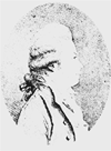
Vicomte de NoaillesDe Noailles Experiences Foul Play The fury of the villains was not long in turning upon the marshal of Noailles, the seignieur who never ceased to spread benefits upon the city of Saint Germain. I had a hunch the district would be against him; a comment of the Property manager while passing by the hotel confirmed it. Finally, he was attacked on royalties that were owing to him, and then on the expropriation of the forest in his park. The good man wished that I leave the unfortunate matter where it was via a memo which offered only the indisputable truths. Here is the letter which he wrote me: "All that comes from you, sir, breathes of the strictest honesty. I made a duplicate of your report to the district, which did not listen to me, but the force of your reasons had an effect upon the Minister."
(162)
" Receive the assurance of my faithful and sincere affection for you. The marshal de Noailles."My Influence Helps Save Lives Later the Minister instructed me to go and see him. We spent more than an hour chatting together. He took measures against the badly disposed constituent bodies and gave me instructions to make repairs to the barracks to receive a regiment of the revolutionary army which spoke only of killing as though they were butchers. The barracks gave me relations with the officers (most of whom were menacing creatures) but gave me the opportunity to save many families. Although I have never admitted it, it gave me inner satisfaction to do good. The plunder and the massacre came to an end, and I believe that my influence on the officers helped to curb these atrocities.
The marshal de Noailles had knowledge of this; here is the letter which he wrote me: "Your humanity, sir, carries consolation to my withered heart. I did not think it possible to have any other emotion than pain. But it seems there still are people with pure aims and sensitive spirits. It is sweet for me in my last moments, sir, to be able to distinguish you and express to you the feelings of gratitude, respect, and affection which you deserve so well. The marshal de Noailles."
It would take several handfuls of paper to describe the happy moments I enjoyed by making myself useful (always with justice) for persons deserving of my most profound respect. If ever the character of an honest man was put to the test, it was mine, and I admit that my heart bleeds when I recall my enemies. There are some that I pity, but I have no sympathy for the greater number.
(163) My Plan to Save Mme DuBarry
Here is a rather striking account which I do not want to pass over without mentioning. A person of the court of Louis XVI came to find me. "I have always been," he tells me, "the enemy of Dubarry, but she is in dire straits and I desire now to save her. I have come to put my secret before you... Do you know any way of saving her? Yes, she no doubt deserves her fate; it is my understanding that...etc. etc. [This is a secret I shall keep absolutely. I shall divulge neither the means nor the persons involved.] It all appeared to me quite simple and straight-forward. The plan involved removal from France to where there was no danger.Bankers asked thirty percent when she reached London the first time and the two millions she had there. The haul was beautiful for the bankers, but she would have got 1,400,000 francs interest on seventy thousand pounds of pension, besides what she had taken.
By thoughtlessness or greed; by haughtiness or meekness, she preferred to return and burn the candle at both ends. When he returned, she did not act reasonably or provide him a guard; instead of being a friend, she treated him harshly; instead of becoming attached to him by the interest he had shown, she was indifferent and this made clubs and committees murmur. One hundred thousand ecus distributed discreetly would have obtained for her the most powerful protection; I knew her coachman, who denounced her and he died a victim of his crime.
Ingratitude Hurts The managers gave me the privilege of being consulted. A lot of cases were being judged on my reports. I put so much detail in exposing the facts that when my opinion was asked for, they said that at least it sounded reasonable. One day, the architect of buildings came home to receive his appointments and said to me sadly, "This is the last time that I shall get them." - "Why so?" - "Because the civil list has
(164)
"no more need for architects. All buildings are to be sold." - "But the forest is surrounded with walls: the guards have their encampment there, so take the title of 'Inspector-General of the walls and buildings of the forest' which need constant surveillance. In fact, I shall give you that title myself in my reports. I will be consulted and I assure you that you will keep your present salary." He did indeed keep them. Mr. D... had to monitor warehouses of construction material, keeping an eye on stores of chains, lead pipe, brass items, boards, and pricing the items to a third of their real value. I protested against speculation caused by greed when I observed that the speculator bought only from the civil list to resell to those on the civil list.In the end, greed got the better of common sense. Looking back on things, I shall say that in these cases there always seemed to be some self-interest associated with favours. Shops were empty and Mr. D...., whose interests I had so well defended, lost his position. I had obtained for him the position of conservator of buildings with a salary of one hundred pistoles, and I accommodated him very comfortably. Would you believe it? This man became my enemy because he wanted to get the equivalent salary of the abolished position with that of the new. For me this was a sad observation. If those who haven't experienced kindness have few friends, at least they don't have enemies. And while an enemy has no more than a hundred friends to serve, he has the advantage of never having to be obliging.
I Meet Robespierre I had forgotten in my wallet a letter for Robespierre, that a member of the Academy of Arras (to which I belonged) had asked me to give to him. This letter for which I had not begged, portrayed me as a writer who had some education and a talent for writing. Finding myself in Paris, I went to give it to him.
[Note: Arras, a city in north-west France (Flanders), was the birthplace of Maximilien Robespierre, 1758-1794. He was 36 years old when he was guillotined after an unsuccessful suicide bid in which he had shot away a part of his jaw.]Robespierre, having read it, looked at me thoughtfully
(165)
and gave it to one of his secretaries, who, a moment later says to him, "He is one of us!" Robespierre gave me a grin and asked me for my address. I left somewhat dissatisfied with the impression I had left behind.The next day the secretary came to find me and, in a familiar tone, invited me to have lunch. "Your colleague of the Academy of Arras," he says to me, "asked me to convey his compliments." We talked through lunch. "You seem, sir," he says to me, "qualified to acquire some easy money, position, accommodation and influence." - "What would it take to earn so many favours?" - "It would be necessary for you to do some writing - perhaps twenty five or thirty pages a week for which we shall supply you all the materials. We could arrange to have you work with Camille Desmoulins." (Now this chap was an impertinent scoundrel, born in Guise and launched by Mirabeau into the career of the revolution which I detested).
"Sir," I said, "I'm not a writer, and having anything to do with contemporary politics is something I could not get enthusiastic about." - "It will be worth your while." - "Please convey to Mr. Robespierre my appreciation for the high regard he has for my feeble talents and for his kind offer to improve my situation. But tell him that I have an important mission and that it isn't possible for me to accept his kindness."
If I had asked for an interim position as administrator of domains, I certainly would have gotten it. The emissary frowned and told me frankly that he would report my refusal. Then he went out, leaving me very worried indeed because to refuse entry into the infernal cave of the Jacobins was to make one suspect.
A Hailstorm Ruins Me I returned to Saint Germain. Finally the civil list was reunited in domains, and by an administrator to whom
(166)
I was and had become committed. This was the biggest mistake which I had ever committed in my life. The fact is, that by staying I believed that what was owing to me would be paid to me. Mister Clavière's project was to send to me to Switzerland where I would not have become a victim of injustice.It so happened that in 1792 a terrible hail storm struck Saint Germain which broke some 14,000 francs worth of window panes belonging to the civil list, including those of the greenhouses whose ruins still remain. Instantly all the tenants pounced on me as a single body and the district summoned me to make repairs immediately. I carried to Versailles a report of the damages and the director instructed me to have the repairs made. 'The tenants must be properly enclosed and covered'.
I then employed all the glaziers in the city; I gathered the reports made by the building inspector; I got myself the order to pay by the district, and I gave all these reports to inspector Rougane who, living at Versailles and having relations with the department, was the man in charge of this function. Would you believe it? The state control caused me to lose 80 percent on this operation, but I shall return to this later.
It was at this time that big things started happening.

St. Germain's forest (which Isaac saved) with the Chateau
in the foreground where he was imprisoned and nearly executed
during the French RevolutionI Save the Forest of St. Germain The citizens declared that because freedom and human rights were decreed, they were allowed to get wood from the forest because it belonged to them. I told the guards, "Do your duty. Pursue the delinquents and chastise them severely!" - "On whose orders?" - "On mine." - "The citizens will kill you." - "Well, I too am a citizen of honor." The firmness of these unpopular commands contained the nearby villages, restrained the plunderers, and saved the forest. I fully expected to be denounced to the revolutionary committee, but I believed that the state control, by ordering me to put myself on the line, had every intention of backing me up. I believed that in any case, it would plead my cause with the powers that be. Not at all!
(167)
It delivered me up to the fury of the mob, grew indifferent and finally abandoned me.An Old Lady and a Tree A very old English lady who was quite disabled, and who lived in a chateau, sent for me with a request to come and see her. I hurried over. "Sir," she says to me, "all my movement is restricted to walking the distance between my bed and this armchair, and then from this armchair back into my bed. And all my pleasure consists of looking at the passers-by. Outside is a small tree with branches which block my view. Could you possibly see that it gets pruned?" - "I don't foresee any problems with that, Madam. I shall take charge of the matter immediately." So I ordered a worker to prune the branches of this tree. But finding it too small to climb and without roots, he decided not to prune it, but to rip it out by using only the force of his arms.
Immediately the door sentinel of St. Germain's chateau denounced me as a profiteer for cutting down trees to sell them for my own profit. So then a member of the district arrived at my home who asked me with sincerity to explain why I had brought down some trees. "Sir, please follow me to one whom you will respect and whose testimony will serve as my answer to your question." I took him to the English lady (who repeated the request that she had made to me), then in a ditch we located the 'pruner'. - "Did I order you to bring down this tree?" - "No." - "Then why did you bring it down?" - "It was the weight of my body which brought it down. Besides, here is the tree. I haven't removed so much as three twigs from it." - "You see, sir," I said to the representative, "that my 'destruction' was worth no more than fifteen sols; that the cause was accidental in any case; and that it was a question of performing a service for a 90-year-old woman." - "That's fine. I didn't believe the vindictive door sentinel anyway. I will prepare my report. You can rest easy, sir; your actions were praiseworthy." This fair man was a monsieur Couhert.
In Defense of Shrubbery Some days later an eager artisan made a proposal in which he offered to charge 200 francs for a job that wasn't worth 60 francs, namely to clear the ditches of the
(168)
chateau of all the elders, shrubs, heath, and bushes which were growing there. Upon receipt of this proposal I replied that I saw some major drawbacks with it. I was then reported to the revolutionary committee and to the (Jacobin) club for ceaselessly opposing work that would be of benefit to the nation. Sentiments having been stirred against me amongst the higher authorities, a member of the convention arrived who asked me why I did not want to sell some useless bushes. I asked him to grant me a half hour to formulate my response. I then observed to this representative:
- That the ditches were tiled and consistently lacked any drainage.
- That every apartment block had latrines and kitchen wastes which emptied into the ditches.
- That the person who had the idea of planting elders and other spongy shrubs in the ditches had reasoned well because the vegetation absorbed the putrid gases.
- That without this vegetation the ditches would quickly become a cesspool which not only would be unsightly, but capable of infecting the chateau and its neighborhood, and perhaps even producing an epidemic.
- That shrubs worth some 20 francs paid for in assignats were not sufficient inducement to expose the city to a high level of danger.
- Finally that if there were any doubt, the matter was worth taking up with doctors and chemists..
"Sir," says the representative to me, "I had come to reprimand you, but your reasons are striking and honourable. Certainly they will be welcomed." Undoubtedly they were because there was no further mention about this affair.
Accused of Favoring Aristocrats The apartments of the civil list (bureaucracy) elicited envy and made the citizens complain. To quell this murmuring I suggested renting out all the flats and prepared a report tending to prove that many people who now enjoyed this lavish
(169)
accommodation and the conveniences in their homes had enormous expenses which they paid, and that it would be inequitable not to give them an advantage (in the price of the rent) if they would factor into their property rates such things as partitions, alcôves, etc., etc. As a consequence it would be necessary to charge two rents, one for the occupants and the other to cover the cost of vacant apartments; to name a building architect, a master mason, a district commissioner, and one for the municipality to pay a general visit and fix with equity the price of every rent. This plan seemed wise and was instituted.Prévost, a carpenter and member of the district was called upon to preside over this operation. Having worked with us for two days and noticing that everything was done well and fairly, he says to us, "Go your way and see me when it is completed." However, when it was time to sign the report, not only did he refuse his signature, but he overlooked the fact that I had been only a bystander in these proceedings. He wrote to the department accusing me of having favored the aristocrats, an allegation which would have been disastrous to me if my director, a just and honorable man, had not proven to the deputies of the convention that the rates had been determined by the constituent body, among whom the very one who had denounced me had the dominant voice!
Foiled Entrapment Then there occurred a very unusual incident in the municipality. I laugh at it now since it had no annoying consequences, but it shows how craftiness and stupidity conspired to work against the same individual.
I had dined at the home of the administrator of domains where he had given me a very moving written lament about the misfortunes and sufferings of the Royal Family [Louis XVI and Marie Antoinette]. Instead of handing him my plan of rent rates to municipal workers, I handed back to him the written lament. He opened it and says to me, "Are you mocking me? It is a song." I took it from his hands and I gave my report to another person standing nearby. "Hold this," I said to him
(170)
laughing, "Here is a song." - "Bah! He does not know how to read," and then I fled. It is certain that this 'song' received by another hand would have been sent to Robespierre, and that he then would have taken his revenge for the refusal which I had made to his overtures.I Take Custody of Art Treasures I received a letter from Monsieur Clavière addressed at Surenne where he was staying. "I am miserable," he said, "I never see you anymore which amazes me because we know each other so well. Come and have dinner with me as soon as possible. Give your reply to the one who conveys this message and he will get back to me. But do not ask him any questions."
I went to see him the next day. - "You have a right to complain about me; you were not paid for the expenses which I caused you to incur. I hope that we shall give it some consideration. The hundred thousand ecus which I mentioned to you have vanished from our hands. Two hundred persons swamped me; they arrived with checks drawn by the municipality of Paris. To refuse to pay them would have increased the mass of my enemies". As tears poured from his eyes, I didn't say a word about my own interests. He went on. - "I have little hope and I do not hesitate to confide in you. Follow me."

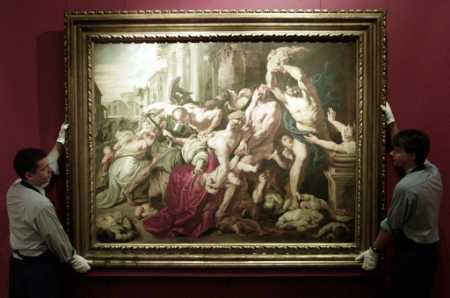
"Massacre of the Innocents" by RubensHe led me into a big room. - "Here is a painting which is in doubt. I have been offered one thousand louis for it if it is original, and only one thousand ecus if it is a copy. You know about such things," he said to me, "what do you think of it?" - "I believe it to be by Rubens." - "Examine it with care." It was the "Massacre of the Innocents", on which there were more than fifty figures.
I decided to focus on the drawing of the eyes, to see if I would find everywhere the same purity in the outlines. Then a remarkable observation appeared and I exclaimed, "It is original!" M. Clavière, a little taken aback, approaches. - "What proof do you have?" - "Here is a hand which has six fingers. The artist found this hand lacked grace because he had made a mistake,
(171)
but he didn't erase the finger which he didn't want to keep. A copyist would not have left this oversight in." - "Your observation seems brilliant to me and I shall have it appraised accordingly."Then he took me into his confidence. - "I am coming to the end of my life; I know it, and my fortune consists now of six boxes of paintings. Would you be a man to save it from the present turmoil?" - "Let's discuss the matter... Certainly you do not want to lose me. Monsieur, your son-in-law lives in Geneva. Make it appear that he is sending me these boxes without your name appearing on them. The boxes could leave here at night with a bill of lading dated Paris. The accompanying documentation would include a letter which appears to come from your son-in-law to me regarding these paintings. The letter instructs me to prepare a docket listing the contents of each box, and requests me not only to display the paintings but even to sell them if I find the occasion to do so. With these precautions I would have the means to defend myself if I am denounced. You see, the boxes are bulky, the sentinel at the entrance of the chateau is a villain, and they have to pass under his eyes." - "This plan seems excellent to me." And then he wet my face with his tears. - "My fortune will be at your home in a few days. As for me, I consider myself sacrificed, but I shall not die ignominiously. Mark my words... The horrors which you have seen are only a prelude of what is to come." Monsieur Clavièr killed himself with his knife and his wife, an excellent person, poisoned herself.
The question will inevitably arise, why did I stay in such a cesspool when, carrying a name respected in my homeland, I could have lived with my brother?
- I was engaged in work that kept me busy, and I had committments.
- I would have had to appeal to the assemblies of the canton and thus compromise my principles.
- I would have been offered inducements and by refusing them, I would have exposed my wife to perils.
- I preferred to suffer injustice from outsiders rather than from my own countrymen.
(172) My Kindness Repaid By Hostility I forgot to mention a man who lived on a national farm. A famous actress desired this house, and probably by her charms enjoyed the representatives' benevolence. This man came to find me, crying, moaning and begging for my protection. - "I am not the sort of person, sir, who can protect anybody, but there is a justice who has absolute authority over me who, I believe, would support your cause." I prepared his report and it succeeded in spite of the powers devoted to the comedienne. I remained unknown, but people had their suspicions, and I thereby made enemies amongst some opposing Members of the National Convention. We shall soon see how I was rewarded for this important service...
This farmer, lacking money to bring in his harvest, came to me with a confidence which pleased me. Asking me for 400 francs I gave it to him by way of corsets which were worth money. But as soon as this man had no more need of me, he turned his back on me and had the audacity to blame me for the means by which I had rendered service to him. He did more; in the scarcity he paid me off with three bushels of rye and three of potatos; by making sure that I was the last one served; and by refusing me this help up to the point where he didn't even have any more. What this example taught me is that men are the same everywhere except that with savages, gratitude, far from diminishing, increases with time.
The Wood of St. Germain The forest of Saint Germain was being considered as a source of wood to build vessels. It wasn't possible to make a worse speculation. Wood from this forest burns well enough,
(173)
but it rotted in the air and in water some fifteen years sooner than that of Marly. This experience was well-known because after a multitude of accidents, it was forbidden under Henri II or Henri III, to make joists or beams using wood from Saint Germain. If it was used to make staves, tubs or barrels, they lasted only a short time while it was certain that those of Marly would last for a long time. Both forests were near to each other so I looked for a reason to explain these facts. Here is my opinion. The wood from Saint Germain contains a lot of salts, and these salts in the water cause the fibres to absorb water which hastens their decomposition. The wood from Marly, on the other hand, contains a lot of oil which will not mix with the water. I expressed my conclusions but nobody listened to me.It is a travesty that all the wood hewn from Saint Germain for the navy was sent at great expense to ports where it was used merely as fuel to boil the water of sailors. I noticed that the agents of this enterprise were merely conventional wood merchants with absolutely no knowledge of naval shipbuilding. Logic is no match in a contest with greediness.
State-Approved Plundering A representative of the people arrived at St-Germain and came to see me, inviting me to have dinner. - "Undoubtedly you have some beautiful things here." - "Yes, the chapel of former kings is rather rich in vestments and sacred vessels." - "Could I see them?" - "Certainly. When you wish I will summon the sacristan and have him show us all the things that he has custody of."
Magnificent vases, superb ornaments and vestments embroidered with pearls cause the people's representative to go into raptures. Then he went out and returned with suitcases, seizing everything and giving a nod of appreciation to the sacristan. Such was the power of certain legislators, and what interested them most was to know where there was more spoil to be taken. The same thing happened in Versailles, but
(174)
on a much larger scale. The pirates of the Convention descended on it with wagons.I Am Arrested Finally, the arrests began. A wood merchant came to warn me about it. "You are not on the list," he says to me, fully aware that the exact opposite was true. In fact I was the first one on the list and I deserved to be because I had thwarted the devastation of the forest. This act of deceit is all the more remarkable because this man, as a former debtor of the civil list, also had the biggest outstanding debts to me.
I was arrested in my bed at three o'clock in the morning, and it is the door sentinel of the chateau who executed the arrest. The big grievance of this villain concerned my refusal to have a complete apartment built on to his lodgings. Named Tombe, he held a pistol two thumbs from my head. Lighting the way was Aubouin, a schoolteacher and the one who had denounced me. He had also become my judge and a signatory of my guilt. Fifteen armed men accompanied these two brave souls. My first reaction was to burst out laughing. When they asked me why I laughed, I replied that a midget with a pistol in his hand was a very comical sight at three o'clock in the morning. Tombe was no more than four feet, six thumbs tall.
I owe my life to my presence of mind because a very dangerous bit of verse was lying on my table which I had meant to burn. Here is the subject of it: Death, wanting to choose a Prime Minister, considered all the woes in nature, each of which pleaded to be appointed. Death then selected Robespierre who united all of them.
To divert the eyes of my two enemies, I took a pencil and began working on an unfinished picture which stood on the mantle of my fireplace. - "Ha! Ha! You are an artist?" - "Yes, but since I consider you to be a little bit turbulent, I am going to put my picture away for safekeeping. I'll take it into my alcôve." - "By God! Let's see what else you've done... Go ahead." Then in the wink of an eye the incriminating piece of paper was placed under my armpit. Then I opened a box. - "What are you doing?" I removed a piece of paper and casually placed it on the table. Then
(175)
as I went to the alcôve, I said to them, "You may make mischief but you won't find anything amiss. The proof is in my calmness. My faith! You don't scare me." - "Is that so? Let's see your papers!" - "Here are my boxes." - "Where is your correspondence?" - "Here." - "Your manuscripts?" - "I don't have many. Here are some bundles of verse." - "'Bouquet for madam de Narbonne'! So you have relations with this family!" - "No. This is a bundle of verse that nuns and old folks asked me to make for the abbess of Origny who also is called 'Narbonne'. You are holding the rough draft. Here is the final version. Take it and read it." They folded the paper and seized it. - "At least take this one which leaves no doubt." - "We want the draft."It was clear these scoundrels had evil intentions. - "Do you have any papers which speak about the government?" - "Yes. Here is the tabloid "Pere Duchêne" [Hebert's salacious newspaper] and "L'Ami du Peuple" ["Friend of the People", Marat's tabloid] of Marat." - "What? Do you read that?!" - "Did I do wrong?" - "Oh, No!". After a meticulous but incomplete examination of my room, they withdrew as satisfied with their exploit as I was to have escaped such great danger. Later two officers arrived and I put them at ease by offering them a good lunch. Thus I obtained all the time necessary for me to allay my fears and put into security all the things which I did not want to lose.
My 'Crimes' Perhaps one would not be irritated to know the kind of spirit and the way things were done at the time. Here is a typical warrant for arrest signed by second-hand clothes dealers, wig makers, carpenters and shoemakers:
COMMITTEE OF REVOLUTIONARY SURVEILLANCE OF M... B... Dated 26 Thermidor of the year Segont of the French republic, one indivisible and imperishable.(176)
C... apprehended by the Minister C... denounced for professing the principles of the aristocracy, having violated the municipal authority by refusing to give information as requested by the law in the municipality. Having been regularly allied with persons condemned by public opinion, for not being in sympathy with the revolution, he refused to give a certificate of residence in the municipality, in consideration of these facts the aforementioned citizen was considered by the committee to be put before the law on 12 August 1793 (v.t;) For that purpose the committee of ...... arrested him on 17 September 1793.
Signed: The members of the committee:
B …. L … C … D … F … L … J .. B …. J ….My crimes were thus: to have been appointed by Clavière; to not have wanted that the municipality get involved in my business; to not have had residency long enough to obtain a civil certificate; and finally, to have been seen in good company.
My director prepared a very sentimental appeal on my behalf. This kind gesture engraved his name into my heart and it will never fade, but the state control which twenty times exposed my life to danger by its orders, and for whom I sacrificed myself, far from protesting my innocence, deigned neither to seek justice for me, nor to attach the slightest merit to my dedicated service, while my colleague at Versailles, a terrorist, made them tremble, and obtained what he wanted.
Aiding Prisoners at Récollet Convent From the courtroom of St-Germain's revolutionary committee (then Montagne-bon air) I was driven by two policemen in Versailles to the Convent of the Récollets, where I found numerous people and good company. There I met Duport de Tertre, a princess Sérénissime, and several other persons in high places whom I had never bothered in the past to obtain favours.
(177)
Madam de Bourdie (made popular by Voltaire), an infinitely kind woman, came to pay us the most pleasant visits.I have the honor of resembling Benjamin Franklin to the point where I have been mistaken for him. This philosopher had been the friend of this Lady, so she called me 'Franklin', and throughout my long captivity I carried this name.
Madam de Bourdie asked me to prepare her defence. It was not easy because she was accused of having sung in her verses about the King, the Queen and all the court.
I prepared this report and Dupont Dutertre, finding it very good, said to me, "You would certainly not make your own defence with this precision." - "Why?" - "It is because when we do it for someone else, we always say more than we would for ourselves." And then he asked me to work on his too.
Here are the first verses which this Lady with the beautiful spirit had the kindness to send me:
In this confinement where regrets reign,
Geniuses and doleful hearts together,
The sky still has reserved for me some blessings
Because in what you offer me I see the traits
Of a gentle friend who served me like a father;
In this fleeting favour,
My heart dares not reach for security,
Of Franklin you are the image
And of the august truth,
You know as he did, how to speak the sweet language,
But for him it created freedom,
While you are now in bondage.I heard that this lady's report was received favourably and that she was being set free. Here is the note she gave me over this bit of good news.
Nothing was better made than this report,
To its author, I am in debt,
For who would have believed
That his verses would lead me to glory,
And his prose to liberty.(178)
Some days before going out, she came to pay a visit to our barracks with two or three pleasant women of her society. We strived to be upbeat to amuse them and the conversation fell on paintings. - "You like art, gentlemen, please do not refuse to do a portrait of me. It will be the moment of prison that I shall preserve." I wracked my brains, but nothing came out. Then I went to my corner which I called my 'office' and gave birth to this quatrain there which the situation impressed upon me.Apollo gave her the palm of genius
Minerva placed in her heart all the virtues,
She was ennobled by the accents of [Greek god]
And by the attractions of [another Greek god].The lady had left us no more than a quarter of an hour when I received this poem in return:
It is to merit only that one must pay homage;
Rarely, you know, to sublime talents
Do we grant a legitimate fragrance,
But, in an envious world, I abhor its customs
In reading the works you made for
Your new Sisters, I see that virtue refused nothing to you;
Educated in all the arts, your enlightened spirit
Accepts even the right to endure suffering.A very kind lady for whom I had made all the sketches in letters to her mother, wrote under the poem the following lines:
This name represents the model
Of an apostle of sensitivity;
Love would have been a natural response
If friendship had not kept its vigil.No doubt I'll be blamed for my vanity, but then, who doesn't have a little? Besides, I hereby prove that a prison isn't necessarily devoid of the charms of pleasant society.
(179) Lifting Morale
We had a rather large number of comrades who were given up to despair. Without hope they cried ceaselessly while others walked around dumbly with crestfallen eyes. Regrettably some people's fears came true.
A Recollet CloisterThe convent was our daily walk, women on one side and men on the other. Here is a recipe which I scribbled on the walls during my two walks.
Regimen suitable for prisoners:
Twelve pounds of patience,
Two pounds of tranquility,
A spirit cleansed with prudence,
Then in sufficient quantity
Add some salt of cheerfulness,
For your flagging hope.A squad of armed scoundrels brought in a new and very interesting religious unfortunate. Even without her religious garb she stood out. She cried, bearing the marks of intense pain. Just as I walked by, a lady took her by the hand and led her up to the graffiti regimen which I had written. - "It is very good," she said, "but the one who wrote this recipe can still change his clothes. Everything has been stolen from me and I would have died from hunger if the jailer hadn't admitted me into the kitchen to serve as a dishwasher."
I approached this girl and spoke with her. She had a sweet voice, good language, an easy manner, and she showed me her papers. - "My child," I said to her, "you are in the right. Those who arrested you are thieves. Unless I miss my guess, you will not have to sleep here. Come with me." I dictated to her a letter for the president of the committee, and I attached a copy of her certificates. Two hours later the order came through to have her released. She came back to thank me with an expression of sincere gratitude but without the least hint of joy. - "What is to become of me now? How can I travel 60 leagues on foot? Everything has been taken from me and I don't have a sol. And how
(180)
shall I escape the dangers which will surface everywhere?" This was grist for a second letter to the president which I made her write. Without mentioning restitution but focussing on her miserable plight, she was granted reparations.Then I led her to the ladies who set about making her some luggage. The men also pitched in to help her with expenses on the road, and I closed the matter by preparing a report which she presented to the authorities and by which she obtained a pension which she still enjoys today. How I slept that night! I didn't need a narcotic. Coincidentally I met this nun recently. Her heart recognized me immediately as did her eyes, and I enjoyed the pleasure of seeing her happy. She was living at Maubert-Fontaine in the vicinity of Thiérache.
My Name Is Called I was at the Récollets for two weeks when I heard a hoarse voice shout at midnight, "Crommelin!" - "Here I am." - "Get up. You are wanted." - "Should I take along my belongings?" - "No." - Then, addressing my cellmates I said, "Gentlemen, I'm going into the lion's den. I wish you all good-bye and best of luck."
I was taken to St-Germain, not to my office but to another prison. As I had braced myself for every eventuality, I expressed no outward moroseness. As it happened, the jailer was sick and I had to spend the night in a straw chair. A foreign prisoner, an educator and a very intelligent man who had travelled to the four corners of the world, alleviated the boredom. He handed me a letter requesting that I mail it for him. - "But, sir..." - "I know... it is open, and I just want to be prudent."
At an early hour I was summoned and in passing by a post office, I gave the letter to a policeman. - "Go ahead, read it." - "I won't bother to open this one," he said, tossing it into the mailbox.
I was led to a room where I confronted
(181)
three or four deputies, commissioners of the district and municipality, a revolutionary committee, and more than fifteen others all calculated to intimidate me. And at the head of all these was the inspector of the state control. - "You were in charge of two accounts - an old one and a new one. Produce them." - "You knocked over my papers (perhaps to embarrass me) but I shall remedy the situation. Here are my account books." My serenity and a few lighthearted quips amazed the assembly. - "You owe on the old account 34,000 francs." - "Yes, perhaps," I said to the inspector, "but you know that there are 1100 pounds owing to me. But I ask you not to include them now in the accounting which you are about to make." - "You owe on the new account some 14,337 francs." - "Let's see that account. Now why did you not subtract what belongs to you from what you owe me as I had asked you to do?" - They didn't flinch. - "This is a definitive account leaving nothing out. Gentlemen, this man is attempting to show you a debit which does not exist. Indeed, here is the proof in the 14,337 francs balance once the monies owing to me have been factored in." Then what a commotion! People were listening attentively. "Gentlemen, you can report what you have seen here." The onlookers filed out of the room with long faces. I saw the police commissioners scatter and stop some people to recount the news of the day.Making An Inventory Representatives of the convention approached me and said some honest things to me, but as for the partisans of the corrupt system, they hated me because I had acted only to preserve things. The one who had destroyed the chapel was amongst them. He drew me aside and said, "I have a duty to perform which embarrasses me; it is to do an inventory of the furniture storehouse at the Venery. Can you tell me the procedure I should follow?" - "If you wish, sir, call back and I shall hand you a draft which should enable you to accomplish the task in less than an hour." - "What's to be done?" - "Just give me the order." - "Alright, you have it." - "But these two policemen
(182)
will hamper me a lot if they intend to make as many steps as I plan on doing. Certainly I do not intend to escape." Then, he ordered the policemen to let me go wherever I wanted.I returned to the home of Lemaire. In the furniture storehouse I asked him to have twelve or fifteen workers come and lower all the furniture into the big stable, taking care to separate all the different sorts of things and to note precisely the quantity of each item. About ten o'clock in the evening, exceedingly tired, I went to report on my labours and to carry an inventory the verification of which would require no more than an hour. - "I hope, sir, that you will allow me to sleep in my own bed." - "No, it is necessary that you return to Récollets." - "I travelled all last night, sir, and had a sleepless night. Now the work which I have just done for you has exhausted me." - "I tell you that you must return to Versailles." Thus injustice was added to this harshness. The representative even refused to compensate me for the expenses which I had just incurred on his behalf. Thus I returned to Récollets and even though I was known at the prison, it was necessary to answer one thousand questions all over again.
Merriment in Prison At this time the author of "the Marseillaise" [Rouget de l'Isle] entered, having been apprehended for a crime of muscadinery [comic farce]. Indeed, he was guilty of comic farce in the first degree! He was a little bit hunchbacked, proud, quietly satirical, and considered himself the first man about town. There was a vacant bed in our barracks which he immediately commandeered, and this didn't please too many people.
We also had a general and a bishop. The bishop was a small man who was loud, vain, proud and obnoxious especially when we enjoyed ourselves. I do not know what we had eaten on a certain day, but nobody slept. The most pronounced cannonades multiplied on all sides, even from the vicinity of monseigneur which, of course, hurt his dignity. When the fumes subsided, a crazy cheerfulness took the place of the artillery, and I was not the least fertile in jokes.
(183)
Finally the bishop shouted over to me. "Mister Crommelin," he said with his light voice more like that of a young choirboy, "you would have been an excellent buffoon." - "Yes, monseigneur, if you had been my partner, we could have made a lot of money!" - "How so?" - "If we had attached the tail of a monkey to you, we could have announced to the public that you were the king of the Apes. And with me dressed like a clown, I would have shouted for all to come and see the rarest of all the monkeys - one who likes to be dressed in purple. 'He speaks like a reasonable person, and has the voice of a cold woman'. Then taking your skullcap to take up a collection, we would have made considerable receipts."I also would have attached the tail of a cod fish to the base of your spine and you would then have been taken for a maritime monster having returned from the coast of the island of Madam Gaspar (Madagascar). And still dressed as a clown I would have invited people to come to see the maritime creature who had paws like those of a small bear and a voice like the grunt of a sucking pig which was choking. Finally, I would have had you wrapped up, and you would have been an Egyptian mummy which I would have called 'Crotocus' or 'Pendocus', famous names in the 'Illiad'." I was irked, but merriment had been the result The joke lasted more than a quarter of an hour.
Never was there heard in prison such roars of laughter and noise. The jailer got up, and I believe even the general was suppressing a laugh. Meanwhile the bishop complained about the fact that I had swamped him with ridicule and sarcasm. The response he got was that the cameraderie which he helped foster by cheering up the prisoners and mustering the courage of a clown whose profession it was to generate laughter and applause, was well worth the general amusement which I had got at his expense. - "What? So it is I who was wrong?!" - "Yes, and we all reprimand you for it!" - "Well, in that case I shall apologize." He came and approached me, but I was ready, and it was I who apologized to him. We lived as good companions, and I had a lot of influence over him, helping him decide to lay aside
(184)
the ecclesiastical trappings which made him the object of ridicule and which drew attention to our barracks.Prison Intrigues Finally, the inspector came around to bring me 1150 paper francs in denominations of five, ten, fifteen, twenty five and thirty sols. That's when I became a banker in the prison. The author of 'the Marseillaise' [Rouget de l'Isle] drew me aside and asked that I lend him 300 francs for three or four days. I embraced him and counted out the money to him. A month went by without him saying a word to me, and he eventually left the prison without even saying where he was going...
Saint Germain's revolutionary committee demanded that all its compatriots be put in the castle and their services be appropriated upon demand. Thus all the people from St. Germain left and I was the only one excluded from the lists. Finally, at the request of good Madam Lemaire, I was summoned.
It is impossible to relate all the devious means we employed to obtain either news from the outside, rumours of rumours, or finally some assistance. But I assure you that prison induces craftiness which we do not suspect ourselves capable of when we are free. Girls from four to five years old brought us letters sewn into their dresses.
There was, however, a particular room where two people could be alone together. Entry to this place cost 25 francs. Young ladies from Paris came to have dinner there rather often and there was in this respect reciprocal discretion. I saw even very respectable women risking their reputation for the security of their friends or relatives. The Committee did not know it, but interest in these liaisons guaranteed the complicity of the jailer.
We Bribe Our Jailer Here is a rather unusual thing which happened to me at Récollets...
Our jailer had a gentle appearance but it was a deception which gave us a false opinion of him. Although he appeared quite candid, he reported to the committee all that took place. I saw the wolf under the sheepskin and cautioned the other prisoners to be on guard.
(185)
The brother-in-law of this jailer, named Mistrolet, was a butcher who was ordered to knock out all the priests. There was a rather large number of them in prison so I cautioned them not to meet together, or at least to not do any singing.I sensed the need to tame this wild animal and since money was the most powerful means, I convinced each of my companions to give him fifteen sols per day. From our barracks that made a total of two hundred and seventy francs per month. Thus our door was no longer closed at night and we avoided the dirtiest and the most uncomfortable of all the inconveniences.
The September Massacres One day this man made a sign for me to follow him. He led me to one of the crossings of the dining hall, and said to me, "Prisoners have been massacred in the jails of Versailles and there is talk of coming here. Look, there is eight feet between here and that flight of steps. Do you see that door over there?" - "Yes." - "Well, if what I foresee comes to pass, that door will be open, you can count on it." - "Mistrolet," I said, handing him fifty francs, "please accept this. I would not offer you this token of appreciation if it did not concern all the barracks which likes you as much as I do." He thought for a moment and realized that the affection of the entire barracks was behind my gesture, something he considered a major bonus. The massacre did not take place. Undoubtedly a place so vast instilled a fear of vigorous resistance, and it is certain that we would have sold our lives for the highest price possible.