The Memoirs of Isaac Mathieu Crommelin |

|
22 - Becoming a Skillful Copy Artist 23 - A Sword Fight in Paris 24 - The Ambassador of Venice 25 - I Meet Diderot 26 - A Devilish Prank 27 - My First Excursion to Dublin 28 - A Merry Departure from Dublin 29 - 'Doctor' Isaac Crommelin 30 - Befriending a Thief 31 - Mr. Panorama |
32 - My Mother-in-law 33 - My Wife and Son 34 - In Pursuit of Richard Behan, Embezzler 35 - A Troubled Second Voyage to Dublin 36 - John, the Dishonest Clerk 37 - An Eventful Ride to Dover 38 - Return Voyage as a 'Prisoner of War' 39 - A Surprise Reunion 40 - Triumphant Homecoming 41 - Demise of the House of Crommelin |
Becoming a Skillful Copy Artist If you put pebbles in the bags of a miser, he will go on enjoying them, believing them to contain that which he no longer has. In Saint Quentin there was an esteemed man named Bourdon whose portrait, painted by Clavare, was the object of dissension and even division within the family. I went over to look at the portrait; examined it in detail, and I dare say suggested that I make a copy of it.
Patience, loving attention to detail, and constant comparison were the means which I used. In the end my copy was of such a calibre that of the two portraits it required a tough decision on the part of the one who competed for the original to decide which one he wanted.
(25)
Undoubtedly because of his lack of knowledge, mine was chosen. It is true that to seduce the eyes, I had given more coolness to the costume, and a more pleasing vagueness at the bottom. This approach pleased me because it reconciled the family.A Sword Fight in Paris My father, aware that I had worked hard in England, sent me to spend a fortnight in Paris. I went to see an Italian comedy which was then in the street Monconseil. I then went to the flower gardens and by a stroke of bad luck, accidentally stepped on the toes of a pale and bilious man, gravely marked by smallpox. I made my honest apologies but was surprised to be called a stupid idiotic fool. He responded by putting his foot on mine. "Remove your foot," I said to him. "You only felt the point of mine, now I shall use my heel." The hard exchange and threatening commotion drew the attention of park wardens and I voluntarily left the spectacle rather than get myself ejected.
Then I was in the rue Saint-Denis, looking into a pastry shop, when I suddenly felt the blow of a sword against my head. Swiftly I drew my foil and swept savagely down on the aggressor, drilling him within the space of six seconds. I saw my man fall into the pastry shop and then I fled. Arriving pale at the house of my aunt, I found there an old serviceman who was an acquaintance and told him about my adventure. He made me aware that I was still holding my naked sword in my hand and couldn't conceive how I was able to traverse so many streets in Paris without being arrested. The next day I entered the pastry shop and had some small pâtés there for lunch. The proprietor was happy to talk so I asked him what had taken place the day before. He told me that the wounded man was a doctor known to be excessively irrascible; that witnesses swore that he had drawn his sword against a fellow who peacefully had crossed his path, and that this fellow, in self-defence, had given him a strike
(26)
from his sword. Besides, he was not badly wounded and lived on Saint Martin Street.My Encounter with the Ambassador of Venice A crueler affair then occurred to me during the same journey. The Ambassador of Venice made his official entrance at Versailles where an officer of the guards admitted me to the courtroom to observe the ceremony. I heard the speech of the Ambassador and the response of the king seated on his throne, and I saw the Ambassador present his credentials.
In the evening, when it was fairly late, I entered a coach stationed at the entrance of the main avenue and found an Englishwoman inside who was crying because she had left a sick child in Paris. Having no one to look after him, she had already made the trip four times and she was afraid she could not leave now in this coach. - "Madam, I am pleased to make your acquaintance. I believe I can reassure you and say that we shall all leave together." At that moment four men appeared wearing the livery of the Ambassador - celestial blue clothes with silver braids. One of them in a most authoritarian tone ordered us to come out of the coach. - "Do you have an order?" - "Yes, here, look." So I came out and read it by the light of a lantern. - "Yes, the coach is yours, but as a favour please leave this lady. She is a foreigner with a sick child in Paris." The lackey then struck me, that is to say he smacked my cheek, and said to me, "Don't worry about the kid." I landed a punch on the jaw of the rather strong lackey and broke five or six of his teeth. Then four naked swords were leveled at me. I defended myself and managed to strike some but I received a sword strike to the shoulder and one in the neck. Another one drilled me in the lip while two others split my thumb and cut my finger. Fortunately for me an officer of the house of the king came by just then and when I spoke he listened to me. He said, "I know that the demeanor of an ambassador is very cocky. Better to leave, sir, it isn't wise to use force here. Cochet, conduct the man away from here, he will pay you well."
(27)
The painter Natoire happened to be in the coach and undoubtedly he was there throughout the fray. Meanwhile the Englishwoman was in despair because she considered herself the cause of this bloody scene. She tore a magnificent handkerchief of batiste to make bandages for me. I was soaked with blood right down to my shoes.Upon arrival in Paris, I had myself taken to the home of a councillor of the parlement with whom I had dined. My condition alarmed him and he sent someone out to find a doctor. He didn't want me to return to my aunt's home - the sister of my mother.
"Beware, please," he says to me, "about mentioning this affair to anybody. If you hurt a man or two wearing the livery of the Ambassador, the matter could be very grave. You can thank Providence that you encountered a rather decent officer of the court who ordered the coachman to take you to Paris. Without him you would have been lost. An excellency is powerful on the day of his investiture, and a Venetian Excellency has clout."
As soon as possible I let my father know about what had taken place, and instead of a fortnight in Paris I was there for a month. At the Tuileries I met the good Englishwoman again. She informed me that she was the wife of a lieutenant-colonel and invited me to have dinner with them. She had told him about my experience.
I Meet Diderot The next year when I made another journey to Paris I made the acquaintance of Diderot in a strange way. I was invited to have dinner in the country with this philosopher; he was in a big garden when I arrived. Having been introduced to the gathering and the host, I cast my eye toward Diderot and greeted him personally. - "Sir, it is an honour to meet you." I knew about him, but this was the first time I had actually seen him. "How did you know that my name is Diderot?" - "Because," I said to him, "you are unique with a face like nobody else's in the world."
(28)
He appreciated this comment about his distinctivenss which tickled his fancy. As a result he always treated me kindly, even later on when I consulted him about literary works.A Devilish Prank From England I had brought instruments of physics and astronomy and a valet named Lapierre who swamped me with questions whenever he came to make my bed. I always answered him politely. One day when I was explaining to him the use of an astrolabe, the bizarre notion came to me to tell him that this instrument was used to summon the devil. - "Bah! The devil, I don't believe in a devil." - "You are wrong." - "Well, I once served a priest who laughed at it." - "What! In front of his parishioner?!" - "Yes". - "He was a beast." - "But, sir, honestly, can you show me the devil?" - "Certainly." - "When?" - "This evening." - "I will take you at your word." - "We shall see him." The devil then occupied me all day long. I had some phosphor of Kunkel and a dark lantern. On the glass head of the lantern I painted a death mask (skull) in transparent paint. In the basement of the house there was a wine cellar. When I went down there, I filled a basket of broken bottles and attached a bell to a very small thread.
After these preliminaries, I rented a costume with an extraordinary mask and I coached a young neighbour, the son of a glazier, who was known to be afraid of nothing. He arrived at eight o'clock and I led him down into the cellar. Posing as the valet, I organized a little dress rehearsal with him which really wasn't necessary because the intelligence of the false devil was quite sufficient. So everything was ready when Lapierre came to find me. - "Hey indeed! Shall I see the devil?" - "Not today. Certain preparations are necessary and you'd have to remind me once in a while." - "I rather doubted that you could pull this off." - "I, be put off? Here, follow me." I picked up a book entitled "Palmistry of Bellot" filled with bizarre figures. I entered the kitchen, picked up a lit torch and stepped down into the cellar. There, opening my book, I drew a circle with the torch,
(29)
divided it, and named loudly the twelve signs of the zodiac. Then I placed my astrolabe in the middle of the circle and said to him, "No answer will come if you step outside the circle." I pulled my imperceptible thread of silver and rang the bell. Mr. Lapierre trembled. "You can still withdraw, but later it will no longer be possible." - "Sir, are there dangers to be afraid of?" - "No, not if you do not step outside the circle." Then my hidden helper hurled the basket of broken glass against the wall. - "Do you want to go back upstairs? I shall delay the apparition, but I will have to stay and cannot give you the light." - "Sir, the wine is poured, and I know that you are good." - "Well, in that case be afraid of nothing. Appear, Belphégor!" The devil then appeared with the head of death, and with hands and face made luminous by the phosphorus. Then with a sinister voice uttering gibberish the spectre approached. - "What does he ask for?" - "A commission." The devil then wiggles and seems impatient at which time I approached Lapierre and whispered in his ear, "He is ordering you to go and count all the fishes in the sea. It will require fifty years of your life." When the commission was given, the devil appeared to make attempts to force itself inside the circle, then moved back with an expression of anger, and then finally it fled.I can testify here as to the power of one's imagination. Lapierre saw the devil coming out of the earth. He saw it crossing the wall; it had the head of a monkey, a long tail and feet of mud when all I wanted was to convince him that he lives. Laughingly I told this farce to my father but his attitude became very serious. "There is still in France," he tells me, "districts preoccupied with witchcraft. The farmers in this area believe in the fates and hundreds of times you've heard them say, 'We cast lots to make a decision'. Every rustic evening one speaks only about magicians, werewolves,
(30)
ghosts and people whose necks were twisted by the devil. If your claimed farce perspires, it can cover you with a very unpleasant varnish. This man will now confess to a hypocrite who will elicit your name from him, and then you will be accused of dabbling in a religion. There is an ecclesiastical hierarchy which goes further than you believe. Superstition too has created its own laws which are not abrogated, therefore I reprimand your prank and believe that it is necessary to disenchant this imbecile. Here is my opinion..."I followed the advice of my father but the remedy didn't work in eradicating the misconceptions I had instilled. I saw this Lapierre some 20 years later when he was a café owner in Paris. He was still convinced that I had relations with the devil. "I believe," he says to me, "what I saw and heard that night."
My First Excursion to Dublin I made two extraordinary journeys in Ireland, the productive first one under unusual circumstances.
I went to Ostend via Dunkirk, always travelling along the seaside. Recent storms had taken their toll in these parts of multitudes of vessels generally loaded with grain. The tide had brought in large numbers of corpses, near which I passed. Some wore buckles of silver and others of gold because sailors often wear their valuables on their person. But the idea to do this kind of looting didn't occur to me. Anyway, most of these corpses already had their faces eaten away by the fish.
When I arrived at Ostend, Mr. Hennessey, an English trader, told me about a doctor from Dunkirk who had seen a drowned person tied to a piece of mast and that this spectacle had drawn his attention. To examine it further he dismounted from his horse, removed the bound up body and took it home to his surgery along with his coat and the belts that he wore. Then having employed all the resources of his art, the man began to show signs of life thanks to a relaxation technique which sometimes can revive the dead. Finally he had succeeded in restoring his circulation.
(31)
The first question he put to this unfortunate man was, "What day did you go down?" He answered that his vessel had sunk on Sunday towards midnight. Since he was found on Wednesday he had been at the mercy of the waves for at least two and a half days - inconceivable, but true. Probably the configuration which kept the heaviest part of his body pointed downward kept his head above the water. I met this man and spoke to him. He was tall, lean, well-built, and had an interesting physique.I left Ostend on my way to England in a perfect calm that surprised us. So we put out our fishing tackle and caught mackerel of an extraordinary size. Suddenly I perceived a large commotion and signs of agitation on deck. I asked what this was all about but received no reply. Then I saw two small cannons being loaded, chests being opened, weapons being armed, ointments and lint. Once again I inquired of the captain, but again with wild eyes he did not answer. "Damn it, man - don't you have eyes?!" I looked and saw two big vessels without sails in the vicinity off Dunkirk, but nothing more. Earlier I had paid a sailor generously for a small favour so I asked him what was going on. - "Within two hours," he says to me, "you will be eating French ragout." Then he turns his back to me and through clenched teeth calls me a stupid animal. Then he points out two black specks which I had not seen earlier. Well! Well! Well! There are two armed rowboats coming toward us. I must say in passing that the habit of constant observation has given sailors remarkable eyesight. The two large vessels were English but our crew had taken them to be French. Meanwhile our decrepit little vessel had been built in France. Because of this mistaken identity on both sides the larger vessels had sent out rowboats to board us.
(32)
The two approaching rowboats each carried eleven men. Except for the rowers these men stood with the butt of their rifles resting against their thighs, and each had an officer in the front. We hailed them with a megaphone, then fired a cannon. Finally we recognized the British uniforms. Then there were signs of obvious relief and merriment. Fear and tension gave way to waving hats and cheers from the British, and some came on board to share a glass of punch with us.Earlier I had said to the captain, in the presence of all the crew, that I would not fight because I was not a traitor. But I showed some courage by staying on the upper deck during the fight since I was not ordered below and, despite being an embarrassment, neither did I choose to go to my cabin which I had paid for, or seek shelter in the hold. This conduct was appreciated by the crew who showed their kindness by liberally plying me with punch and getting me drunk without my being able to resist.
The officers of both rowboats, asked me for my wallet. They saw letters of known persons in it and returned it to me with politeness. I said to them that I was on my way to Ireland. - "To Dublin?" - "Yes." - "I hope that you will indeed want to take care of a letter for me." I assured him that it would be faithfully handed over to the intended recipient, and it was done.
I arrived in London, landing at the Tower of London, and as I was taking my place in a vessel bound for Pargate, an unusual event occurred which led to a most fortuitous acquaintance. At the time of departure a charming woman in riding habit arrived with an old and infirm man who walked with difficulty. I offered my place to this gentleman and he accepted appreciatively for the sake of his leg. Then a horse appears and I see the lady preparing to mount the animal. She had been able to book a seat only from Coventry onward so she had decided to ride there before embarking. I said to the lady that she would do me a service and be of use to the respectable old gentleman if she would take my place and accompany him in the boat. - "But it is raining."
(33)
- "Madam, I take after ducks a little - I like water very much." - "Certainly, sir, you are French, but although you like water I hope you will accept this rain coat." It was a wide frock coat of polished silk, with a hood, that wrapped me absolutely and protected me from the rain.We placed a man's saddle on the horse, went our separate ways and met again in Coventry. Pargate is fifty leagues from London and because of the contrary winds we were forced to stay there for several days. Finally we all embarked bound for Dublin.
The famous tightrope walker, Madoc, had just visited these parts with a circus troup and we passed by only a short distance away from his vessel. The wind changed, the sea became very stormy, we tacked for more than thirty six hours without being able to enter the bay of Dublin. Obliged to make a detour, we disembarked at the Isle of Man where I ate the best oysters possible at the lowest prices imagineable. Then we took advantage of a favorable breeze and arrived in Dublin in the middle of the night. The beautiful lady then said to me, "It is hardly possible to find a room at the present hour. You, sir, are therefore obliged to stay at my husband's home. Please give him an arm. He is tired and you also more so than I. I shall lead you there."
We arrive and the gentleman gladly gets himself to bed. The lady and I have a lavish supper and then one carrying a torch arrives who leads me to a beautiful room which was intended for me. The next day, at about ten o'clock, my host and pleasant hostess bring me a broth in person and find me making my preparations to leave. Then my old companion says to me, "I am grateful, sir, for your kindness and the consideration which you have shown my wife. I don't know what it would take to have
(34)
you stay, but the longer you stay the more it would please us. But first I would like to know if you have come to Ireland for pleasure and to examine its attractions, or if you are called here on business. If the former, then I shall put you in good hands. I have horses which you can use. If the latter, I can be of use to you." I said to him that I wanted to settle a bankruptcy because I was French and we were at war. He happend to be a lawyer. He took care of my case which proved to me there was no warfare amongst traders. He won my cause and refused to take anything for his fees.A Merry Departure from Dublin My business thus finished and settled, I made arrangements to embark. All my acquaintances wanted to treat me to a farewell dinner at the Tavern where, according to the local custom of the country, I should be toasted and proceed to get drunk thereby increasing the general merriment and amusement of all.
The Irishmen are the real boys of Europe, and it is not a country where you want to stay at table too long because the toasts and sentiments never end. Now I had a rather nasty cold. "Sirs," I said, "before toasting me at table, I have a request because, as you can see, I have a nasty cough and your intention is certainly not that I should fall ill. I would drink your toasts with pleasure but I must ask that you allow me to have some wine." … "Granted" A carafe of very weak white wine was then set before me, almost like water. I noticed a little later that it truly was time to make my exit. Here is the stratagem which I employed because, in Irish orgies, everything is done to keep one from leaving, and often one is ordered to stay. Noticing a deck of cards on the fireplace mantle, I got up and said, "Gentleman, I am going to make for you a very extraordinary tour. Please shuffle these cards well and give me only one. Then each one of you take two, or three cards and place them under your feet. In five minutes I will come in and name
(35)
the order where the fates had placed them." - "It is not possible!" - "Try it and see." I left the room and went upstairs. Meanwhile the others talked, and waited for me, and got impatient, during which time I was writing something in a nearby cafe. The domestic then arrives. - "What happened to our Frenchman?". - "He went out, but here is a note which he sends to you." The note was opened and on it was written:"Necessity is close at hand;
By taking my leave, good people, I obey his voice.
Your dinners are merry and amiable;
In fact I would find them delectable
If one did not feel locked in;
And I had no need of doctor Carouge
Besides, only red wine, not weak white wine
Can knock one out
Who has come down with a bad cold."I closed with thanks, best wishes and apologies. My flight was not badly taken, because I had a nasty cough and because I had to embark the same night. But the 'tour of cards' made the rounds and I know that it brought many laughs.
'Doctor' Isaac Crommelin Doctor Carouge was a young doctor who had his lodging next to mine. Here is an event I experienced while I was at the home of our hostess.
This lady sends for me one evening to come and have tea with her. A master wig maker arrives, small and thin, with a wig for the doctor. He is asked to wait and we offer him a cup of tea. He gets up and then promptly collapses. I ask the ladies to withdraw and send someone to look for the doctor. When help was not forthcoming I decided to bleed him on an old scar. Since I didn't have a lancet I used a good sharp pocket knife which produced a few drops of blood. Then I made for the patient a demitasse of boiling water. "If he is dead," I say, "it will make him neither better nor worse."
(36)
The doctor arrives. "The cause of death is a seizure," he declares before we buried him. To make sure of it, he made a crucial incision on the cranium. "Besides," he says to me, "you did exactly what I would have done."Befriending a Thief I left Dublin in a schooner which was taking to England a general Noscavres, the brother of the admiral of the same name. The upper deck was covered with oysters, and it was permissible to assuage one's hunger with it. We had to open them ourselves; never had I eaten so many oysters. Our passage took thirty hours.
Arriving at Pargate, the General delegated an aide-de-camp whom I offered to help in running the post office. He gladly agreed. After three leagues at sea, I suffered a great wound. Here is how it happened. I offered my companion a bowl of bumbo, a sort of punch. I was greatly altered by it. A young man who had a very fine appearance, dressed in red, says to us, "Gentlemen, here is a bowl of punch which I have not touched. Let's all drink from it." We accepted his offer and I left the aid-de-camp. Then the red dress says to me, "You seem tired." - "I am." It turns out we're both on our way to London, so why not hire a carriage together and share the expenses? I accepted his proposal and will never forget the lesson which this circumstance taught me. This dandy young man turned out to be a thief - a highwayman. Thus you should never join in a journey with persons whom you do not know.
On the road, on the third leg of the journey which was about nine miles long, my companion started to talk about thieves. He says we have to pass through a wood, and there it is possible to get stopped and robbed. He suggested that if I had any money to give it to him for safekeeping. "I shall put it in my boots," he says. This ridiculous proposition made me suspicions. - "And why would your boots be safer than mine? I find it unusual
(37)
that you should worry about thieves so far from the wood. Besides, I'm not afraid. You guard your side of the carriage, and I'll guard mine." - "You are thus equipped?" - "Always." - "I would indeed like to see French pistols." - "Never. I produce them only to make use of them." When we arrived at the wood I ordered the driver to go the long way round. I am convinced that if I had given my money to this man, he would have concocted some pretext to stop at the entrance of the wood and then disappear. When we arrived at the post station, I requested a place for myself only and said to my companion, "It appears there is some disagreement between us. Besides, I do not know you well enough and regret your company. Now that you know how I feel, it's up to you to continue on your journey anyway you please."I recounted this adventure to one of my friends at Tom's cafe, and I mentioned my suspicions. Then the Englishman says to me, "This man was arrested near London. Waiter! Give me the paper of such and such a day." Then I read of the arrest of a thief whose description matched perfectly that of my travelling companion.
"That business won't take long," he added. "The trial is already underway and he's probably being dealt with at this very moment." A fortnight later we made for Tyburn (the place of executions of felons) - a scary place for thieves, and I saw my man getting up from a cart to go to the gibbet. Turning my head, I crossed the street.
Mr. Panorama What got him in trouble sounded familiar. He arrived on the same road that I took and at about the same time. There was a traveler in a public carriage who had a magnificent ring. This gentleman fell into lively conversation with a fellow traveller who spoke about the beauties of nature, and the pleasure he got from the sight of a beautiful landscape. The sun was about to set and he perceived a likely place to make a stop. "Well, sir. Here you have the opportunity to see the most magnificent view
(38)
that you have ever seen in your life. Let us leave the carriage and go over that hill. A stroll of a few thousand paces will do us good. Besides, if we leave the carriage then within three quarters of an hour we will arrive at the shelter." The walk is accepted and off they trudge up the hill. But the panorama that greeted the gentleman was a pistol by which his ring was asked, without forgetting his wallet. Since that episode the gentleman was known as 'Mr. Panorama'.My Mother-in-law Now I'm twenty five years old and my parents think about seeing me married. My brother having an inclination to live in England gave me his birthright; besides there has never been any jealousy between us.
I married the niece of Mr. P.D.J., dean of the fermiers-general [local bureaucrats who worked for the national government in collecting duties, etc.] It is difficult to quote a more interesting woman, in every respect, than my mother-in-law. The Abbot Raynal was one of the men of wit who came often to see her, and I may say that she sometimes had to constrain the ardour of her imagination.
When he read his works, she would often say to him, "You better change that, Abbot." - "Why madam?" - "Because the character of the writer and his work have to suit each other." We had the satisfaction of spending several years with her wisdom; regrettably this happiness was marred constantly by the bad state of her health. To give an idea of the character of my respectable mother-in-law, here is the last thing she said in life. She sensed that the end was near. In the evening which preceded the night of her death, she said to her two daughters: "My dear children, you are tired. It is your tenderness for me which prevents me from going to my rest. The sleep I go to announces one more good night of grace! So go to your rest. Your presence now can do no more good. Therefore kiss your mother and do not oppose the rest which I need."
All obeyed. A quarter of an hour later Madam D.L.P calls a trusty nurse. - "How happy I am," she says. "I am going to finish my career
(39)
and I have avoided the spectacles of grief from my daughters." Then, folding her hands she looked up at the sky and breathed her last.My Wife and Son After seventeen months of marriage, my wife gave me a son that I had the misfortune of losing when he was only six years old. This was a time when, for reasons dictated by fear on my part and by tenderness on the part of my wife, we adopted the son of my sister - the most likeable and the most grateful of all my nephews. For his age my son had a beautiful hand and dictated well also. I owe the loss of the last letter of my son to the indiscretion of a friend. This friend found me one day with eyes wet with tears while reading this paper. He did not sense that a sentimental reflection is often pleasant in one's solitude and, believing he was doing me a service, he burned it. Though I tried hard to convince him that this kind of pain also has a sort of pleasant side, he did not have what it takes to comprehend.
In Pursuit of Richard Béhan, Embezzler When I was married some twenty months, an extraordinary event occurred which led to my journeys in Flanders, Holland, England and Ireland. A man named Richard Béhan, an Irishman, established himself in Saint Quentin, setting up a big business there. At first he paid very well, but having made many considerable purchases, his anxieties rose.
One evening while going out to a night-orgy, he killed a man and then headed for the hills without forgetting his cashbox and account books. It was believed that he wanted an excuse for running away from his obligations, but I concluded that the murder was a coincidence. Clearly there were easier ways to flee from one's debts without running the risk of being hung.
The next day his creditors came to see if my father too had any interest in the losses that had been sustained. "My son," he says to me, "do not hesitate. Leave - pursue this man and use all your intelligence to serve these
(40)
unfortunates. It is good to be useful to one's fellow countrymen." So I left. I had the last receipts sent between carriers, and before being in Antwerp I found that he had withdrawn some fifty thousand ecus. I went to Holland where I had proof that my man had crossed Mordyk, that he had made it to Rotterdam, and that he had left for Helvoëtluys from there.(Note: Helle-Voets-Luys: C'est un port de l'ile de Vorne, en Hollande. C'est de la que Guillaume III partit, en 1688, pour descendre en Angleterre. Schelling est une petite ile de la Frise.) I armed myself with a general order for the maritime captains, and with a warrant for his arrest which was able to serve me in any situation. Reaching Helvoëtluys, I learn that a passenger ship is about to leave for Harwich. Going to the vessel, I find mister Richard and I show my order to the captain who confronts him.
Richard, who imagines himself to be safe, asks the captain to follow him to the magistrate's office to end this affair and to leave with him aboard. We all went to the office of the magistrate where I produced the order of the government. "Sir," says the Magistrate to him, "You are under arrest," and instantly he calls two strong men wearing badges on their breast.
"Your honour, it is a question of debts. Place, I ask you, the prisoner in a cell and allow me to question him. If I can obtain satisfaction from him, I shall come and have him released." My request is granted and I dine with mister Richard Behan. "I do not want to make you a loser, but be honest. You took your book of invoices, now show it to me." He hands it to me, and I make a list of the outstanding accounts over the last two months. Outstanding is some 250 thousand pounds worth of goods. - "I require that you now place an order to all the creditors whose accounts are outstanding, and to find out who they are let me see your book of copies of letters." The orders were given and to ensure that everything was above board I affixed my signature next to that of the writer. Then he said to me that in England he had goods worth one thousand francs that he would put in my hands if I would accompany him there.
(41)
"I would like that, but make me this declaration in writing with a commitment at the bottom, to pay me this sum in cash or in kind the week after our arrival." His sordid business in Saint Quentin, began to get around and I was afraid that the Ambassador of France might have him arrested as a murderer before I could settle the financial side of things. I had him set free and he was to pose as my valet until I could obtain surety.We arrived in London where he appointed Steele to be his legal representative and thus in reality the custodian of the promised goods. Having been taken by surprise, he ratified the commitment of Richard Behan, made me a note in the amount of 24 000-francs for a two month term, and gave me a bond for the rest on Dublin. I knew this Steele; he was an educated man, knew his business, had respected colleagues, but he himself was a rascal. I didn't have the slightest suspicion of his bad faith at the time or his plan to ruin the manufacturers of Saint Quentin. He wanted to amass a huge fortune, go to India and bring with him Richard Béhan (who according to all appearances, was his illegitimate child) and to live there in opulence.
A Troubled Second Voyage to Dublin So once again in 1758 I traversed England on my way to Dublin. As fate would have it, I meet at Pargate a man named Fletcher who happened to be a rather large debtor of the house of Crommelin. - "Well," my friend says to me, "You could not have come at a better time. I've made some deals so now I have the capital to pay you. My wife and daughter are with me also, so please come tomorrow and have lunch aboard my vessel. We will settle our accounts in Dublin where I am bound in a few days. If you come with us your passage to Dublin will cost you nothing, and I shall also accommodate you there." I accepted his invitation but examined his vessel in light of the rough seas we could expect. The vessel seemed old to me, and in a rather sad state of repair. - "How many men do you have?" I asked him. - "Four". - "Indeed, that seems few for this time of year; we are at the equinox, and the Irish Sea can be dangerous around this time." - "Bah! You have no maritime sense. The water frightens you. Do you believe that I love my wife and daughter less than you
(42)
can love!" The lady and her daughter appealed to me to leave with them but a dark premonition restrained me. I said that I had sound reasons for going to Hely Acad. There was an uncomfortable moment, but I promised to make my peace in Dublin.I indeed departed and embarked on a perfectly well-equipped passenger ship. Unfortunately my premonition came true. My friend Fletcher, his wife, daughter and their fortune were gobbled up undoubtedly not far from land because I knew that Madam Fletcher had been washed ashore by the tide attached to an oar with a handkerchief. This futile precaution had probably been taken at the time of sinking to save her life. This tragedy caused a considerable loss to the the house of my father.
My passage too was difficult - a prodigious sea made me excessively sick. Sea sickness is cruel, it is misery, it is insensitivity perfected, we cannot think and we stay where we are like drunk people. I had a bed, bought for a guinea, and was lying in it dressed. There was also an esteemed family in the captain's cabin including a charming seventeen year old girl who was vomiting so terribly that it greatly alarmed her parents. Her father sounded me out to see if I would be willing to give up my bunk while the mother begged me to give it up by handing me back a guinea. I had to strike a compromise here because I too was ill. "The best I can do, madam, is to offer you half because if I get up, I will surely fall and not be able to get up again. Since the rolling motion of the ship is so severe, have her sleep with me in my bunk. I can care for her." - "Sir, your proposition is preposterous and unacceptable." The father then talks with the captain who mentions to him that I was related to Lord Montgomery [the one who accidentally killed Henry II in a tournament], and the Mr. Hutchinson, dean of Saint Patrick's. Since his daughter was in such a hideous state, he took her and put her next to me, saying, "Necessity knows no boundaries. You, sir, appear to be a noble man. I accept your
(43)
offer." So there I was sleeping with a beautiful girl, but totally incapable of malice. We stayed together for about twenty hours, vomiting alternately, and I was not useless to my partner since I could at least hold her head. Finally she fell asleep, me too, and we slept for fourteen hours. I lived in Dublin with this family. We made jokes of the time when the young lady and I had slept together, and I quite believe that this young person would have become my wife if I had not already been married.I soon learned that the edge [an 'edge' is a notarized obligation] which Stèele had given me was worthless, and that the bond would likely not be paid. I had a feeling that this would be the case, and also that Steele and Richard Behan would likely have left London. I returned there anyway to confirm my suspicions. Indeed my two debtors were no longer there. I wrote them off. Steele had vanished and Behan too had fled. Fortunately I was able to get my hands on some 400 thousand francs worth of merchandise, and this was a coup for their creditors.
John, the Dishonest Clerk A German cousin of my father, daughter of the same aunt who had caused him to lose 100 thousand francs, managed a rather good house in London with the help of a very intelligent clerk, named John. This cousin fell sick and died leaving nothing to an infirm sister. So I went to find John and asked him for a current accounting. "I will arrange," he says to me, "to liquidate everything and recover the capital. I hope to settle with you in eight or ten days, then you will have the accounting for which you ask." Pressed to leave, I returned to master John and learned with indignation that to work on it with 'greater ease', he had taken home the account books and cashbox. A sense of foreboding gave me great anxiety which I communicated to my cousin. I went back to see John
(44)
but he wasn't there. I turned to the neighbourhood to see if anybody had seen anything of John's comings and goings since I had been there last. As it turned out John had brought together all the merchandise and had a quick sale selling off all the goods for cheap prices paid for with letters of exchange. In so doing he realized a fortune of 50 thousand ecu. Some that gave the exchange at the liquidation sale said he had left for Lisbon; others said that he went to America to manage a plantation; while several others declared that he had left for India, boarding a vessel for this country the same day. My relations, reduced to misery, died from sorrow over this setback. Our house too suffered a huge loss and never did we hear anything more about mister John.An Eventful Ride to Dover We had a business relationship with one named Perrots, a young man who had begun with considerable capital, and who was supposed to be a wise man, something which gave him enormous credit. Everything about him carried the imprint of a rich house where administration was in good order. Then this intense young man, in his passions, takes as a mistress a comedienne of lavish tastes causing him to spend excessively; ruins his father and his brothers through promises of very advantageous speculations, and rushes to the abyss. It was at that time when (and nobody suspected it, not even his inmost friends), having given me a magnificent meal, he led me into his study and says to me, "I owe you 60,000 francs. Here it is in good drafts on Paris along with the best endorsements you could ask for. This leaves all business settled between us."
Fate then led me to meet in the stock exchange my friend, Irwin, consul in Ostend for the English nation. - "I leave tomorrow morning," he says to me, "and I too am going to Harwich, where I shall embark for Helweislays. Let us go to Dover together. In any case, by going with me you will avoid a big detour." - "Fine, I'd like that."
(45)
In consideration of due diligence, the camp of Canterbury was advised of our coming because there were fugitives and vagrants in the area making it dangerous to carry large sums of money. This caused Irwin to take a letter of exchange payable on sight, on Dover, and I too included what I had in excess.We were only some men exercising caution: four Genevans who were on their way from London where they had taken a course in watchmaking, Irwin and myself. About eight o'clock in the evening and two leagues from Dover, a man on horseback rode up to the porter asking whether a madam Edwards happened to be inside the carriage. I replied that we had no women here, but plenty of weapons, and that this kind of information was not revealed at night on a main road. Then I ordered the driver to get moving. The rider answered with five or six curse words and then withdrew.
Apparently this rider was a thief who wanted to know if there were any women on board. If there were, he would go ahead and steal. This kind of politeness is general in England where one prefers to lose something without resisting rather than expose a woman to danger.
Voyage from Dover to Dunkirk as a 'Prisoner of War' Arriving at Dover we learn that a vessel exchanging prisoners will leave at 2 am in the morning for Dunkirk. "Here is a good opportunity," says I to Irwin, "Let's take advantage of it. Your embarrassment and mine will be reversed: you, for the departure, and me in the arrival. Let us risk passage. Here is my plan: you will go to the superintendent and he will ask you for your passport of the admiralty..." - "But I don't have one." - "You don't need to know more than that! Begin by giving him two guineas. Then outline your reasons which are good. I shall not go with you, because I would only embarrass you. As for me, I know the captain so I won't have any problem." I take a piece of paper, insert two guineas, fold it in the shape of a letter, and go to the office of the superintendent.
(46)
- "Sir," I say to him, "I am a war prisoner and I have come to ask you to include me in the roster". - "Give me your prisoner's passport." - "Here it is." He opens the paper, and both guineas fall to the floor. He picks them up and says to me, "It is good, it is good!" - "Well, sir, I am not a prisoner, but put my name on the call sheet for loading. But otherwise I do not want to be registered. That is the best way. The matter is concluded and off we go to the vessel, Irwin and I. The captain gives Irwin his cabin because captains always need clerks. The rest of us then get called up, each one answers and we leave. While at sea the 150 prisoners aboard become 150 devils. Here is how that happened.There was a fortnight when the wind was favourable but the vessel remained in port. And, as the government paid a shilling and a half a day to each prisoner, they were unable to get even this weak sustenance. Most, therefore, found themselves without money, without resources and far from home. One wanted to drown the captain, the other wanted to toss into the sea all the sailors and the Englishman - Irwin who was sleeping in the captain's cabin.
Here is how I calmed this excitement.
"Gentlemen, I am a prisoner as you are; I thus have the right to speak. I suggest to you that we have the option of being drowned or hung. Choose. The coasts of France on this side are covered with rocks which you have to be familiar with. You would have noticed that by the winding curves which our vessel has traversed.
"If we commandeer this vessel, we shall die most definitely through shipwreck and even if we land in England we shall be arrested and hung because the right of nations is a sacred right. Furthermore, all your fellow prisoners in England will be harrassed, molested, and maybe even decimated by reprisals." My argument seemed unassailable, at least nobody challenged it.
On arrival at Dunkirk the poor captain received so many
(47)
kicks and punches that he was most embittered - something which even the guard who was watching could not prevent from happening.I advised Irwin to put my address on his luggage, then we climbed together up the rope ladder and walked to the bridge. Finding ourselves within twenty paces of the guard, I said to him, "Move on, and walk slowly".
A soldier cries out to him, "Where are you going, mister?" - "Parbleu!" I answered, "As a resident of Dunkirk he is going home to prepare some lodging for myself." - "In that case, better that he goes to Ste-Barbe, my friend". We were led to the commander of the place; the captain followed us there and complained bitterly about the treatment he had received. The old serviceman frowned and spoke to us in a most austere tone as he took note of the captain's testimony. Then I declared that I was not a war prisoner (which could be verified by the list), but that important business, the handbook of which I now presented, had led me to England. I declared that I had not participated at all in the ill-treatment which the captain complained about. The pilot then explained what had taken place at sea and attributed to me the honor of having avoided a major catastrophe. - "Sir," the commander says to me, "it would be wrong to detain you; here is the pass which you need". I used it to go to the vessel to remove Irwin's luggage and mine. I now ignored my fellow prisoners, but it seemed to me their actions had taken a very bad form.
I went to the home of Irwin's friend. - "That devil you wanted to say to me with your Ste-Barbe!" I told him what had transpired and Irwin was grateful to me for having spared him a lot of questions, fibbing, and likely some delays. A cabriolet transported our luggage to the suburbs; we crossed over bridges with civil guards with weapons at the ready, and finally we reached the dunes.
[Apparently they were now in territory occupied by the British.]
(48) Ostend: A Surprise Reunion and Sumptuous Meal
So we made it to Ostend, late enough to find only the fragments of supper at an inn. We were going to have an omelet and get some sleep, when a sailor comes in to announce commodore Balfour and two captains of frigates. Balfour appears and I recognize my former friend who had lived one year in Saint Quentin to learn French, along with the famous voyageur, James Cook.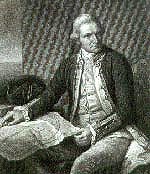
Captain James Cook"Well," Irwin says to them, "We didn't fare too well here as you can see, but we just arrived from England; you are welcome to have supper with me but I fear that you might have to wait a while." - "We shall not wait!" At that moment sailors arrived, one carrying an enormous roast beef, another carried a basket of biscuits, the third had a full load of delicious wines. We had supper without a tablecloth, without napkins, and with our hands. While chatting we drank the wines of Madeira, Tinto, and the Canaries, but by a particular property in the excellence of the wines, nobody got a headache. After the supper, Irwin whispers to me, "We have to confer and do some writing. You cannot be present even if you were English. Anyway, you are tired, go to bed." Balfour and I hugged each other exclaiming over and over, "God bless you my friend." And then we parted, both of us pleased with this happy encounter.
Triumphant Homecoming There was a shipment to Richard Béhan at Ostend, for which I had no invoice. The next day I went over to inspect it, made note of its contents and left for Saint Quentin. The first person I meet there is my son being carried by his nanny. Whoever has never been a father cannot comprehend my emotion at seeing him again. I was in my homeland and I had returned in triumph after a very difficult excursion. I hugged and kissed my wife, my father, my mother, and my brother whom I loved dearly. I related the business
(49)
about Fletcher and my relations in London, and then braced myself for more jolts. The creditors of Béhan began to gather. They were content to have recovered three-quarters of their losses and their gratitude was obvious. I showed them an account of my journey and assured them that it was my pleasure to have obliged them.Demise of the House of Crommelin During my absence a man named Pérard working at the bank in Paris displayed one of the vilest traits which ever existed. He came to find my father, and says to him, "My dear relative, I come to implore your help. I await some major business transactions from Leypzig. They are delayed and it bothers me for the moment. Draw out 12000 francs for me. I will accept it and pay for certain goods, and without losing on the exchange rate you will be doing me a great service." My father told me he showed great disgust in doing this favour, but being a good human being, confident and naturally disposed to oblige, he went along with the transaction. Monsters then went to work, due drafts began arriving, and this business venture went bankrupt. As the major creditor, my father could sue him but he didn't want to do that.
Here is a typical example concerning this bankruptcy. A doctor without patients who was not a creditor, was appointed, I do not know by which means, the overseer of this bankruptcy which had nothing to do with either funerals or pharmaceuticals. Well! This doctor was still my relative.
Some years later, I went to him to see if he planned to make a distribution of the assets. - "A distribution! I doubt there is enough to pay for expenses. The only object on which we can hope to earn seven or eight percent, is in Berlin, but it is a very contentious affair involving minors and a lawsuit. However, if you want to withdraw a portion of your share, I shall pay you five percent." I accepted and he gave me three notes worth 200 francs each which I handed to the manager of the hotel of Chartre for my lodging.
(50)
After being approached twenty times, he was never able to provide a settlement. I asked for more of the withdrawal but in ten letters to him I could obtain nothing more. The doctor then died of a sudden illness and then here comes this complete withdrawal in the hands of his brother, a minister of a church in Berlin. To obtain the execution of the settlement he asked me for certain papers. The legal affair of the debtor in Berlin was over and things generally were much better than we had supposed. I made him aware of how suspicious things looked because his brother, the doctor, did not pay the sum which was owing to me and which I offered to prove with a great deal of evidence. "Besides," I said to him, if he did pay, the notes are in your hands".I discreetly explained the behaviour of his brother; the motives he apparently had, having been appointed overseer of the bankruptcy; his stubborn refusal to act on my letters; and failing to perform the duties associated with his position. Considering, besides, how impossible it is that a clergyman can teach morality through his ministerial duties if he seeks on the other hand to take advantage of an error. The saintly man replied that being an heir of his brother, he would enjoy his rights as a beneficiary, and that I could go and plead my case in Berlin. Then, not being in a mood to go to court over the issue, I appealed to his conscience by proposing to him what I considered a very reasonable settlement. However, I heard no more about this affair and undoubtedly the saintly man of God enjoyed some fruit of the bad faith of the Doctor.
About one month after the bankruptcy of Pérard, I saw my father in his office. Pale and shaking he held letters which he tossed on my armchair. I read the letters and gasped. They contained the news that the letters of exchange which Perrots had given me in London were being challenged - all the signatures had been false. - "My son," my father said to me,
(51)
"We're ruined. We'll have to take drastic measures now. I see no other option."The business community of Saint Quentin then rallied and came to offer one hundred thousand francs. My father answered that he would accept the kindness of the business community until the business could get on its feet again. Some hurried to supply capital without asking for interest, some individuals took charge of a certain item; entire families got involved.
Having written to London for information on Perrots, I received the news that his own family had him arrested on suspicion of theft. The lining of his clothes had been unstitched and in it was found bank notes. For this Perrots had been hung.
In 1761 my seventy-four-year-old father, Jacques Samuel Crommelin, gave up the struggle and retired from business. My mother died that year of grief. [His father died several months later on the rue de Dieu-St. Amour (today the rue des Patriots), between the rue des Canonniers and the place des Campions. Born in exile in 1687 and faithful to the reformed religion, he was refused burial by the church for not having given any indication of catholicism during his life. His son had him interred at Remaucourt in the garden of the country cottage not far from a statue of Hercules. - Berlemont]
My brother, Jacques, eventually took care of the liquidation in 1763, and did so with much honor, exactness and fairness. In the same year, I lost my only child, Jacques, at age 6. He was interred in the St. Jacques church in front of the pulpit. Meanwhile the warehouses in Cadix which had been burned continued to operate at a deficit and my wife, of her own volition wanted to run them. But her fortune having dwindled on capital improvements and new ventures planted over fifty years, her heir eventually secured them, which he assured me was only just and fair.
I then had the bright idea of exporting the wines of Champagne to Russia and bringing back lumber to sell in Holland. However, this project displeased my wife and wise people were brought forward to dissuade me. However the plan itself was excellent. I mentioned it to another businessman who had suffered misfortune and he, taking my idea, managed to restore his fortune. Meanwhile the family of my wife advised me to enter finance. Sir P .. dean of the farmers-generals [bureaucrats who collected duties on commodities] got involved, and I quickly obtained a financial concession with regard to a warehouse of tobacco. This was honest work in which I, a clerk, would
(52)
fill out certain details. It required only four or five hours per month to prepare the government forms such as accident reports with brigades, seizures, and all the other unpleasantries that go along with a career in finance.